

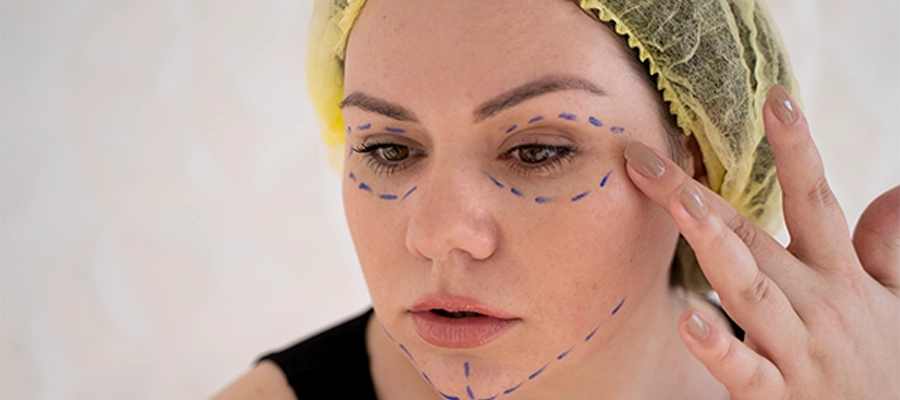
What Is an Extended Deep Plane Facelift?
More extensive release and repositioning of deeper facial tissues distinguishes an extended deep plane facelift from more limited lifting procedures. The operation is designed to address age-related descent across a broader portion of the midface, cheeks, jowls, and lower face while reducing reliance on skin tension.
The word “extended” can describe variations in how far the deeper dissection and ligament release are carried, so it does not represent one universally standardized technique. Surgical planning depends on individual anatomy and the areas requiring correction. The objective is to restore structural support, improve facial contours, and preserve recognizable features rather than simply creating tighter skin.
How Does the Extended Deep Plane Facelift Technique Work?
Deeper facial tissues are mobilized by carefully releasing selected retaining ligaments that restrict their movement. During the extended deep plane facelift technique, a broader area of tissue can then be repositioned as a connected unit instead of relying mainly on surface skin tightening.
This approach may allow correction to extend from the cheek and midface toward the jowls and lower facial contours. Once deeper tissues have been repositioned, the skin can be redraped with less tension. The precise extent of release varies according to facial anatomy, aging severity, tissue quality, and surgical planning. Important nerves and surrounding structures must be carefully protected throughout deeper dissection.
What Makes an Extended Deep Plane Facelift Different from a Standard Deep Plane Facelift?
The primary distinction generally involves how extensively deeper tissues and retaining ligaments are released. An extended deep plane facelift may provide broader mobilization of the midface, cheek, and lower-face tissues than a standard deep-plane approach, although terminology can vary between surgical techniques.
Both approaches aim to reposition deeper structures rather than simply pulling loose skin. The extended method may be considered when facial descent affects several connected regions or requires greater tissue mobility. More extensive dissection can also increase surgical complexity. Neither option is automatically appropriate for everyone. Anatomy, tissue descent, previous surgery, treatment goals, and the degree of correction required determine which approach may be suitable.
Which Areas of the Face Can Be Lifted with an Extended Deep Plane Facelift?
The cheeks, midface, jowls, lower face, and jawline can potentially be addressed through an extended deep plane facelift. The broader tissue release may allow several connected areas to be repositioned during the same procedure, creating smoother transitions between facial regions.
The neck is anatomically related to the lower face but may require separate surgical steps when significant neck laxity exists. Likewise, eyelids, brows, and forehead concerns are not directly corrected simply by extending the facial dissection. Treatment should therefore focus on the areas that genuinely require structural repositioning. Facial anatomy, aging pattern, skin quality, and tissue descent determine how much of the face should be treated.
Treating Advanced Jowls and Lower Face Sagging
Pronounced jowls often develop when deeper cheek and lower-face tissues descend beyond the jawline. An extended deep plane facelift for jowls can reposition these structures and reduce the heaviness that interrupts a smoother facial contour.
Because deeper support is restored first, excess skin does not need to carry the primary lifting tension. This can help improve the transition between the cheeks, jawline, and upper neck. Severe lower-face aging may still require additional treatment of neck structures. Improvement depends on jowl severity, tissue thickness, skin elasticity, skeletal anatomy, and the direction of tissue descent.
Improving Midface Descent and Cheek Position
Age-related descent can shift cheek tissues downward, reducing upper-cheek definition and creating greater heaviness around the lower midface. An extended deep plane facelift for the midface may reposition these deeper tissues toward a more supported anatomical position.
Cheek elevation can also soften some transitions between the lower eyelid, cheek, and surrounding folds, although it does not replace eyelid surgery or volume restoration when those treatments are specifically required. Excessive elevation should be avoided because natural cheek shape varies considerably. Results depend on existing volume, bone structure, tissue descent, skin thickness, and how extensively the deeper attachments are released.
Creating a Sharper Jawline with Extended Deep Plane Surgery
A clearer jawline can develop when descended facial tissues are moved away from the mandibular border. Through extended deep plane surgery, jowls and lower-face heaviness can be repositioned so the transition between the face and neck appears more defined.
Jawline appearance is influenced by more than facial sagging alone. Chin projection, neck laxity, fat distribution, skeletal anatomy, and skin quality also affect definition. Therefore, lifting cannot create the same jawline in every person. Additional neck correction may be necessary when significant laxity exists beneath the jaw. The aim is balanced definition that remains proportional to the rest of the face.
Can an Extended Deep Plane Facelift Improve the Neck?
Lower-face repositioning can improve the upper transition into the neck, but an extended deep plane facelift does not automatically correct every form of neck aging. Loose neck skin, prominent bands, deeper tissue changes, or fullness beneath the chin may require dedicated neck procedures.
When both areas show significant laxity, treating the face and neck together can produce greater continuity along the jawline. The extent of additional neck surgery depends on skin excess, muscle position, fat distribution, and deeper anatomy. Some people need minimal neck correction, while others require more comprehensive treatment. The surgical plan should therefore evaluate the lower face and neck as connected but anatomically distinct regions.
Repositioning Deeper Facial Tissues Without Excessive Skin Tension
Structural lifting works by placing more of the corrective force on deeper tissues rather than relying primarily on stretched skin. During an extended deep plane facelift, released tissues can be repositioned before excess skin is carefully redraped over the new facial framework.
Reducing unnecessary surface tension may help preserve natural contours and avoid an obviously pulled appearance. However, deep-plane surgery alone does not guarantee natural results. Direction of lift, amount of correction, incision closure, facial proportions, and tissue quality remain important. The objective is to restore support while allowing the skin to follow the repositioned structures rather than forcing it into an unnatural position.
Extended Deep Plane Facelift vs. Traditional Facelift
Traditional facelift techniques may combine skin adjustment with different methods of deeper tissue tightening. An extended deep plane facelift generally involves broader release and repositioning of deeper facial tissues.
Both approaches can improve jowls, facial sagging, and reduced jawline definition. The main difference is how deeply the tissues are accessed and how extensively they are mobilized, rather than simply how much skin is removed.
Key differences between an extended deep plane facelift and a traditional facelift include:
- Depth of tissue release
- Extent of deeper tissue mobilization
- Method of repositioning facial tissues
- Correction of jowls
- Improvement of jawline definition
- Treatment of facial sagging
- Amount of structural movement required
- Individual facial anatomy
- Previous facial procedures
- Tissue quality and aging pattern
Extended Deep Plane Facelift vs. SMAS Facelift
A SMAS facelift works with the connective and muscular layer beneath the skin through tightening, folding, or repositioning. An extended deep plane facelift differs mainly in the depth and extent of tissue release before the tissues are repositioned.
The extended deep plane approach typically releases selected retaining ligaments to allow greater tissue mobility. SMAS techniques can also provide significant improvement without the same level of deep release.
Key differences between an extended deep plane facelift and a SMAS facelift include:
- Depth of surgical dissection
- Extent of tissue release
- Release of retaining ligaments
- Degree of tissue mobility
Extended Deep Plane Facelift vs. Standard Deep Plane Facelift
Both procedures operate within deeper facial tissue planes, but the extent of mobilization may differ. In an extended deep plane facelift vs standard deep plane facelift comparison, the extended technique generally involves broader ligament release and dissection to increase movement across selected facial regions.
Terminology is not completely standardized, so the actual surgical steps are more meaningful than the procedure name alone. Some people require wider midface and lower-face mobilization, while others can achieve appropriate correction with a less extensive approach. Greater dissection also means greater technical complexity. Treatment should therefore be based on individual anatomy and the amount of tissue movement necessary to create balanced correction.
Endoscopic Deep Plane Midface Lift Cost 2026
The Endoscopic Deep Plane Midface Lift Cost 2026 varies according to surgical complexity, anesthesia, location, degree of cheek descent, and whether additional facial procedures are performed.
Frequently Asked Questions
Preparing for an Extended Deep Plane Facelift
Medical conditions, previous facial procedures, medications, supplements, smoking, and treatment goals should be reviewed before an extended deep plane facelift. Because the operation involves significant tissue repositioning, factors affecting bleeding, circulation, and wound healing require careful consideration.
The First Week After Extended Deep Plane Facelift Surgery
The earliest recovery period commonly includes swelling, bruising, facial tightness, tenderness, and temporary changes in sensation. During the first week after an extended deep plane facelift, the cheeks and lower face may look fuller or temporarily uneven because postoperative swelling does not resolve uniformly.
Swelling, Bruising and Facial Tightness During Recovery
Visible swelling and bruising generally decrease progressively during the first several weeks, while deeper changes take longer to resolve. Swelling after an extended deep plane facelift can persist subtly even after someone appears socially recovered. Tightness and firmness may also remain as repositioned tissues adapt.
When Can You Return to Work and Social Activities?
Many people need approximately two to three weeks before feeling comfortable returning to typical work or social settings, although recovery varies. Returning to work after an extended deep plane facelift may take longer when bruising, swelling, or combined procedures remain noticeable.
When Do Extended Deep Plane Facelift Results Look Natural?
As prominent swelling subsides, facial contours gradually become softer and more representative of the eventual outcome. Extended deep plane facelift results may begin looking considerably more natural within several weeks, while subtle refinement continues for months.
How Long Does Extended Deep Plane Facelift Recovery Take?
Visible recovery generally progresses substantially during the first few weeks, but complete extended deep plane facelift recovery can continue for several months. Bruising and prominent swelling tend to improve before residual numbness, tightness, firmness, and subtle swelling completely disappear.
Risks and Possible Complications of Extended Deep Plane Facelift
Bleeding, hematoma, infection, scarring, asymmetry, altered sensation, hairline changes, and wound-healing problems are possible extended deep plane facelift risks. Temporary swelling, bruising, tightness, and numbness are common during normal early recovery.
How Long Can Extended Deep Plane Facelift Results Last?
Structural improvements can remain noticeable for many years, but an extended deep plane facelift cannot permanently stop facial aging. Repositioned tissues continue aging from their new location as skin elasticity, facial volume, bone structure, and supporting tissues gradually change.