
What Is Facial Scar Treatment?
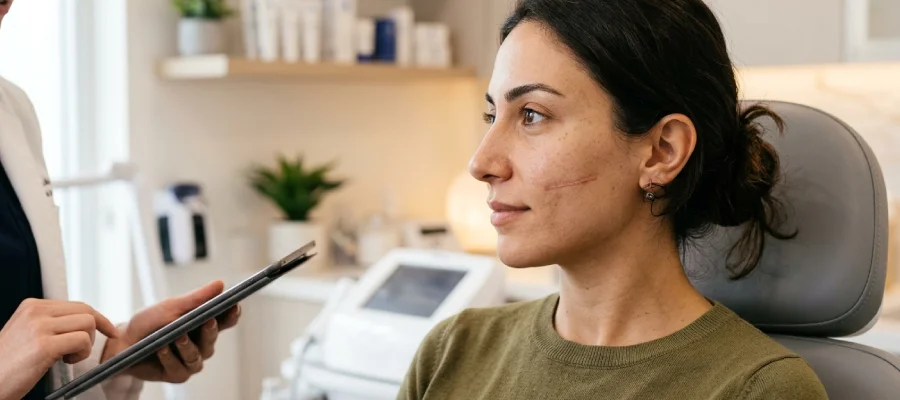
Facial Scar Treatment includes surgical and nonsurgical methods used to improve a scar’s color, texture, thickness, depth, position, or overall visibility. Treatment cannot completely erase a scar, but it can often make the affected area blend more naturally with surrounding skin.
Options range from silicone-based scar care and injections to laser procedures, microneedling, resurfacing, subcision, and surgical scar revision. The appropriate method depends on whether the scar is raised, depressed, wide, discolored, contracted, or irregular.
Scar age, facial location, skin type, previous treatments, and individual healing patterns also influence planning. Some patients benefit from one procedure, while complex scars may require several complementary treatments performed over time.
What Causes Different Types of Facial Scars?
Facial scars develop when the skin repairs itself after acne, injury, burns, surgery, infection, or other forms of tissue damage. Facial Scar Treatment varies because different healing responses produce different scar patterns.
Excessive collagen production can contribute to raised hypertrophic scars or keloids. Insufficient tissue formation or deeper tissue damage may produce depressed scars. Acne can create ice-pick, boxcar, and rolling patterns, while traumatic wounds can leave irregular or widened scars.
Genetics, wound depth, infection, inflammation, skin tension, sun exposure, and individual healing biology influence scar formation. Identifying the underlying scar type is important because treatments that work for depressed scars may not be appropriate for raised scars.
Which Facial Scars Can Be Treated?
Facial Scar Treatment can address many types of scars, including acne scars, surgical scars, traumatic scars, hypertrophic scars, selected keloids, depressed scars, widened scars, and irregular scars.
Treatment may also improve persistent redness, pigmentation differences, surface roughness, or tethering associated with a scar. However, each characteristic may require a different approach.
For example, a depressed scar may benefit from subcision, resurfacing, or volume correction, while a raised scar may require silicone therapy, injections, laser treatment, or carefully selected surgery. Deep traumatic scars can sometimes require reconstructive techniques.
The degree of improvement varies. Scar depth, location, age, skin characteristics, and previous treatment history all influence the options and expected outcome.
How Is the Right Treatment Selected for a Facial Scar?
The right Facial Scar Treatment is selected by evaluating the scar’s type, depth, thickness, color, texture, location, and relationship to deeper tissues.
A scar should first be classified as raised, depressed, widened, contracted, discolored, or a combination of these characteristics. Acne scars also require further assessment because ice-pick, rolling, and boxcar scars respond differently to treatment.
Skin type, pigmentation tendency, previous procedures, medications, and history of abnormal scarring should also be considered. Treatment goals are equally important because complete scar removal is generally unrealistic.
Combination treatment is sometimes more appropriate than relying on one technique. Different procedures can target separate components such as pigmentation, surface texture, tissue deficiency, or excessive scar thickness.
Treatment Options for Acne Scars on the Face
Acne-related Facial Scar Treatment depends on whether scars are rolling, boxcar, ice-pick, raised, or a mixture of several patterns.
Microneedling and fractional resurfacing can improve selected textural irregularities by stimulating controlled skin remodeling. Subcision may help rolling scars that are tethered to deeper tissues. Certain narrow and deep scars may require focal techniques or surgical removal in selected cases.
Volume loss beneath acne scars can sometimes be addressed with fillers or autologous fat grafting. Raised acne scars require a different approach and may respond to injections or other scar-directed treatments.
Because acne scarring is often mixed, a staged combination plan may provide more balanced improvement than a single treatment method.
Approaches for Raised and Thick Facial Scars
Raised scars require Facial Scar Treatment that addresses excessive scar tissue rather than simply resurfacing the skin.
Hypertrophic scars remain within the original wound boundaries, while keloids can extend beyond them. Treatment options may include silicone products, pressure where practical, corticosteroid injections, other intralesional treatments, and selected laser procedures.
Surgery may be considered for certain raised scars, but recurrence is possible. This is particularly important with keloids, which can return after surgical removal and may require combined management.
The treatment approach depends on scar thickness, symptoms, location, growth pattern, skin type, and previous therapies. Flattening and softening the scar are generally more realistic goals than complete disappearance.
Treating Depressed and Indented Facial Scars
Depressed scars may require Facial Scar Treatment that addresses both surface texture and the tissue beneath the visible indentation.
Some depressed scars develop because fibrous bands pull the skin downward. Subcision can release these attachments in suitable cases. Microneedling and resurfacing procedures may improve surface irregularities and stimulate remodeling.
Deeper volume deficiencies may sometimes be treated with dermal fillers or fat grafting. Narrow, sharply defined scars can require different procedures from broad rolling depressions.
Treatment selection should therefore be based on scar structure rather than depth alone. Several sessions or combined techniques may be necessary when different scar patterns exist across the same facial area.
Options for Post-Surgical Facial Scars
Post-surgical Facial Scar Treatment can address scars that remain wide, raised, depressed, discolored, irregular, or poorly positioned after an operation.
Newer surgical scars may initially be managed with wound care, sun protection, and silicone-based products when appropriate. Persistent redness or textural differences may later be treated with selected laser or resurfacing techniques.
A widened or poorly positioned mature scar may require surgical revision. The existing scar can sometimes be removed and the wound closed more precisely or repositioned along more favorable facial lines.
Timing matters because surgical scars continue changing for months. Unless there is a functional problem, sufficient healing is often allowed before deciding whether further treatment is necessary.
Facial Scar Treatment After Cuts, Injuries and Trauma
Facial Scar Treatment after trauma depends on the depth of injury, quality of initial wound healing, tissue loss, and whether deeper facial structures were damaged.
Minor scars may primarily require treatments targeting color or texture. Deep traumatic scars can become depressed, widened, irregular, or attached to underlying tissues. These problems may require subcision, resurfacing, volume correction, or surgical revision.
Significant injuries can also cause tissue loss or contracture. Reconstructive techniques such as local tissue rearrangement, grafting, or flap surgery may then become necessary.
Treatment should consider function as well as appearance, particularly when a traumatic scar affects the eyelids, lips, nose, or normal facial movement.
Laser Treatments for Facial Scar Improvement
Laser-based Facial Scar Treatment can improve selected problems involving scar texture, redness, pigmentation, and thickness.
Different laser technologies have different purposes. Vascular lasers may target persistent redness, while fractional ablative or non-ablative treatments can stimulate controlled remodeling in selected textural scars. Some pigment-related concerns may require other carefully chosen laser approaches.
Laser treatment cannot correct every scar. Deep tethering, substantial tissue loss, severe contracture, or major contour irregularities may require additional procedures.
Skin type is especially important because some patients have a greater risk of post-inflammatory pigmentation changes. Laser settings, treatment intervals, and the number of sessions should therefore be individualized.
Microneedling and Resurfacing for Facial Scars
Microneedling and resurfacing are forms of Facial Scar Treatment commonly considered for selected acne scars and surface irregularities.
Microneedling creates controlled microscopic injuries that stimulate a remodeling response within the skin. Fractional resurfacing similarly creates controlled treatment zones while leaving surrounding tissue available to support healing.
These techniques may gradually improve texture and shallow depressions, but they cannot replace missing deep tissue or release every tethered scar. Deep scars may require subcision, volume restoration, or surgical techniques alongside resurfacing.
Several sessions may be necessary, and improvement develops progressively as the skin remodels. Treatment intensity should be adjusted according to scar type, skin characteristics, and pigmentation risk.
When Is Surgical Scar Revision Considered?
Surgical Scar Revision may be considered when a facial scar is wide, irregular, contracted, deeply depressed, poorly positioned, or does not respond adequately to suitable nonsurgical treatments. The existing scar may be removed and replaced with a more carefully planned closure.
Techniques such as Z-plasty or other tissue rearrangements can also help change scar direction, release contracture, or improve alignment. Surgery cannot eliminate scarring completely, but it may create a less noticeable or more functional scar.
Factors that may indicate Surgical Scar Revision include:
- Wide scars
- Irregular scars
- Contracted scars
- Deeply depressed scars
- Poorly positioned scars
- Scars resistant to nonsurgical treatment
- Functional distortion
- Eyelid pulling
- Restricted lip movement
- Need for scar excision
- Need for Z-plasty
- Need for tissue rearrangement
- Scar maturity
- Individual treatment goals
How Does Skin Type Affect Facial Scar Treatment?
Skin type can significantly influence the planning and response to Facial Scar Treatment. People with greater skin pigmentation may have a higher tendency toward post-inflammatory hyperpigmentation after procedures that create controlled inflammation.
Other characteristics such as skin thickness, oil production, sensitivity, sun exposure, and a history of hypertrophic scars or keloids may also affect treatment choice. These factors do not necessarily prevent treatment, but they can influence safety, recovery, and the number of sessions required.
Skin-related factors that influence Facial Scar Treatment include:
- Skin pigmentation
- Risk of post-inflammatory hyperpigmentation
- History of hypertrophic scars
- History of keloids
- Skin thickness
- Oil production
- Skin sensitivity
How Long Does Facial Scar Improvement Take?
Improvement after Facial Scar Treatment develops at different rates depending on the scar and treatment method.
Some changes, such as reduced scar redness after appropriate treatment, may become noticeable relatively early. Treatments that depend on collagen remodeling usually produce gradual changes over several weeks or months. Multiple sessions may be required.
Surgical scar revision creates a new scar that must pass through the normal healing process. The revised area may initially appear red, firm, or raised before gradually softening and fading.
Scar maturation commonly continues for 6 to 12 months and sometimes longer. Final improvement depends on scar biology, treatment type, skin characteristics, sun exposure, and postoperative care.
Facial Scar Treatment Prices 2026
Facial Scar Treatment Prices 2026 vary because scar management can range from relatively limited nonsurgical procedures to complex surgical reconstruction.
Frequently Asked Questions
Can facial scars be completely removed?
Complete removal is generally not a realistic goal of Facial Scar Treatment because scar tissue represents a permanent change in the skin’s healing structure.Treatment can instead make a scar flatter, smoother, lighter, narrower, or better blended with surrounding skin. The degree of improvement depends on scar type, depth, location, age, and individual healing.
What is the best treatment for an old facial scar?
The best Facial Scar Treatment for an old scar depends more on its characteristics than its age.A mature depressed scar may benefit from subcision, resurfacing, microneedling, volume restoration, or a combination of treatments. Raised scars require approaches that address excessive scar tissue. Wide or irregular surgical and traumatic scars may be better suited to surgical revision.
Can deep facial scars be improved?
Deep scars can often be improved with Facial Scar Treatment, although they may require techniques that address structures beneath the skin surface.Some deep scars are tethered by fibrous bands, making subcision potentially useful. Others involve actual tissue loss and may require fillers, fat grafting, surgical correction, or reconstructive techniques.
How can a raised facial scar be flattened?
A raised scar may be flattened through Facial Scar Treatment selected according to whether the scar is hypertrophic, keloid, or another type of thickened scar.Silicone-based products and intralesional corticosteroid injections are commonly considered for appropriate raised scars. Other injection treatments and selected laser procedures may also be used depending on scar characteristics.
Can acne scars be treated permanently?
Acne-related Facial Scar Treatment can produce lasting structural improvements, but describing acne scar treatment as permanently removing scars would be inaccurate.Procedures such as subcision, microneedling, resurfacing, and selected surgical techniques can create long-term changes in scar structure. However, the amount of improvement varies according to whether scars are rolling, boxcar, ice-pick, raised, or mixed.
When should treatment for a new facial scar begin?
Some aspects of Facial Scar Treatment begin during early wound healing, while more intensive procedures are usually considered later.Appropriate wound care starts immediately after an injury or operation. Once the wound has closed sufficiently, measures such as sun protection and silicone-based scar management may be recommended depending on the scar and treatment plan.