
What Is a Male Brow Lift?
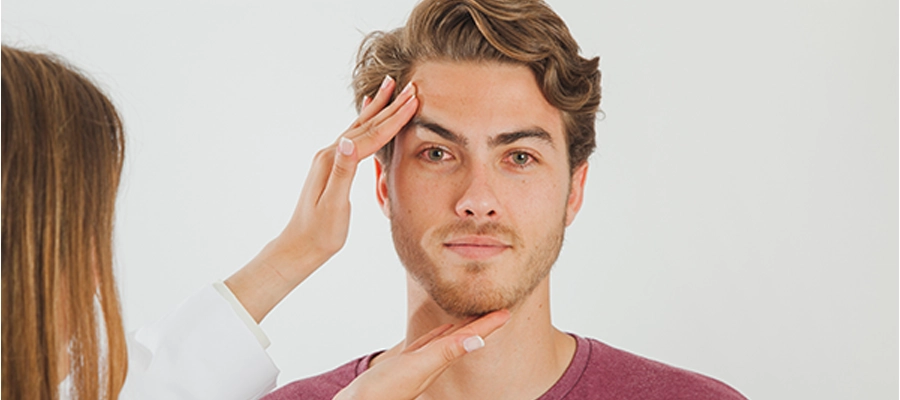
A male brow lift is a surgical procedure designed to reposition descended eyebrows while preserving the stronger, generally flatter characteristics associated with a masculine upper face. The procedure can address low brows, asymmetry, lateral brow descent, and heaviness around the upper eyelids.
Surgical planning differs between individuals because eyebrow shape, forehead height, hairline stability, skin quality, and facial proportions vary considerably. Endoscopic, direct, or temporal techniques may be considered depending on anatomy and the degree of brow descent.
How Male Brow Anatomy Shapes Surgical Planning
Male eyebrows commonly sit closer to the upper orbital rim and tend to have a flatter contour than the more arched brow shape often requested in feminine facial planning.
These anatomical relationships influence the direction and amount of surgical elevation. Raising the central or lateral brow excessively can change the character of the upper face. Forehead dimensions, orbital anatomy, brow thickness, hairline position, and natural asymmetry should therefore be evaluated together before determining the intended position.
Why Men Often Develop a Heavier Upper-Face Appearance
Age-related tissue descent can lower the eyebrows and increase fullness above the upper eyelids. Thicker skin, forehead anatomy, and changes in soft-tissue support can further contribute to a heavy appearance.
Some men compensate by continuously activating their forehead muscles to raise the eyebrows. This may contribute to prominent horizontal forehead lines. Treatment should determine whether the heaviness originates primarily from brow descent, eyelid skin excess, or a combination of both.
Restoring Brow Position Without Creating a Feminized Look
Brow repositioning in men usually emphasizes restoring support rather than creating a pronounced arch. The objective is often to reduce heaviness while maintaining recognizable masculine facial characteristics.
Surgical elevation should consider the patient’s natural eyebrow shape instead of applying a standardized position. Small adjustments can significantly change expression, particularly around the outer brow. Conservative planning helps maintain a natural relationship between the brows, eyes, forehead, and hairline.
Keeping the Male Brow Flatter and More Horizontal
A relatively straight eyebrow can contribute to a stronger upper-face appearance. During a male brow lift, the central and lateral portions can be repositioned selectively to preserve this flatter orientation.
Excessive elevation of the outer third may create an arch that does not match the patient’s desired proportions. The surgeon must therefore consider lifting vectors as well as overall height. Natural brow asymmetry and forehead muscle activity also influence the final contour.
Correcting Low-Set Brows That Make the Eyes Look Tired
Low eyebrows can reduce the visible space above the eyes and create a tired or heavy expression. Repositioning descended tissues may make the upper eye region appear more open.
Not every tired-looking eye is caused by low brows. Upper-eyelid skin excess, eyelid ptosis, under-eye changes, and facial volume loss can contribute independently. Identifying the anatomical cause helps avoid unnecessary brow elevation and determines whether another procedure should be considered.
Male Brow Lift for Upper-Eyelid Heaviness
A male brow lift can reduce upper-eyelid heaviness when eyebrow descent pushes forehead tissues downward toward the eyelids.
True excess eyelid skin will not necessarily disappear after the brow is repositioned. Upper blepharoplasty may therefore be considered when both problems are present. Brow height should generally be established before determining how much eyelid skin can appropriately be removed.
Treating Uneven Brow Height in Men
One eyebrow naturally sits higher than the other in many faces. Aging, muscle activity, previous surgery, or facial nerve differences can make this asymmetry more noticeable.
Surgery can sometimes adjust each brow independently to improve balance. Perfect symmetry cannot be guaranteed because underlying bone structure and dynamic muscle movement remain different between sides. The aim is usually to reduce noticeable asymmetry without making the eyebrows look unnaturally identical.
How Forehead Height Influences Brow Lift Technique
Forehead height affects both incision planning and the visual impact of eyebrow elevation. Raising already low eyebrows can expose more forehead, which may be undesirable when the forehead is naturally long.
Patients with shorter foreheads have different proportional considerations. Surgical planning therefore evaluates the distance between the eyebrows and hairline alongside brow position. The technique should improve upper-face balance rather than considering eyebrow height in isolation.
Hairline Considerations in Male Brow Surgery
Hairline position is particularly important when selecting a surgical approach. Scalp-based incisions may be relatively inconspicuous in patients with dense, stable hair but more visible when hair density is limited.
The surgeon should also consider the likelihood of future recession. An incision that is well concealed today could become more noticeable if the hairline changes substantially over time. Alternative approaches may be preferable when hairline stability is uncertain.
Male Pattern Hair Loss and Brow Lift Incision Placement
Male pattern hair loss can influence whether scalp incisions are appropriate. Progressive recession or thinning can expose scars that were originally hidden within hair-bearing areas.
A direct technique may sometimes provide an alternative when significant brow ptosis requires correction and scalp access is less desirable. Procedure selection should consider current hair density, family history, recession pattern, forehead anatomy, scar tolerance, and the degree of brow elevation required.
Preserving Masculine Forehead and Brow Proportions
Masculine upper-face proportions are influenced by brow height, brow ridge projection, forehead slope, orbital anatomy, and eyebrow shape.
Repositioning soft tissues should respect these structural relationships. A lower, flatter brow may remain appropriate even after correction. The objective is not to reproduce a predetermined masculine template but to improve heaviness or descent while maintaining facial characteristics that suit the individual.
Endoscopic Brow Lift for Male Patients
An endoscopic brow lift uses small scalp incisions and camera-assisted visualization to release and reposition deeper forehead tissues.
It can be considered in men with suitable hairline anatomy and early to moderate brow descent. The technique provides broader forehead access without a long coronal incision. However, future hair loss must be considered because scalp scars can become more visible if surrounding hair thins. The amount of elevation should also remain conservative to preserve a natural brow position.
Direct Brow Lift in Men with Significant Brow Ptosis
A direct brow lift uses an incision immediately above or close to the eyebrow. It can provide precise correction for significant brow descent and may be particularly useful when scalp-based incisions are unsuitable.
The trade-off is a scar positioned close to the brow. Dense eyebrow hair, forehead lines, skin characteristics, and individual healing can influence scar visibility. The direct technique also allows each eyebrow to be adjusted independently when substantial asymmetry exists.
Temporal Brow Elevation for the Outer Third of the Male Brow
Temporal elevation primarily targets the outer portion of the eyebrow. It may be considered when lateral descent is more noticeable than central brow lowering.
The amount of movement should be carefully controlled in men because aggressive elevation can create an excessively arched appearance. A relatively subtle adjustment may reduce lateral upper-eyelid heaviness while maintaining a flatter brow contour. Patients with broader brow descent may require a different technique.
Male Brow Lift Prices 2026
Male Brow Lift Prices 2026 vary according to the selected surgical technique, degree of brow descent, anesthesia, location, and whether additional procedures are performed.
Brow Position During the First Weeks of Healing
The eyebrows can initially appear higher or less symmetrical than expected. Swelling, fixation, and early tissue tension all influence brow position during the first weeks.
Swelling, Tightness and Temporary Scalp Numbness
Swelling, tightness, bruising, tenderness, and temporary changes in sensation can occur after brow surgery. The exact pattern depends on the surgical technique.
When the Upper Face Starts to Look More Rested
The upper face generally begins appearing more natural as swelling decreases and the eyebrows settle. Noticeable improvement may develop over the first several weeks, while more subtle changes continue for several months.
Avoiding an Over-Lifted or Surprised Result in Men
Avoiding overcorrection requires careful control of central brow height, lateral elevation, and brow shape. Excessive lifting can alter masculine upper-face proportions and create an unnatural expression.
Factors That Affect Long-Term Male Brow Position
Long-term eyebrow position depends on tissue quality, skin elasticity, surgical technique, fixation, forehead muscle activity, genetics, and continuing aging.