
What Is an Endoscopic Deep Plane Temporal Lift?
A targeted upper-face procedure can reposition descended tissues around the outer brow and temple without lifting the entire forehead. An endoscopic deep plane temporal lift uses hidden scalp incisions, camera-assisted visualization, and deeper tissue release to elevate the brow tail and surrounding temporal structures.
The operation focuses more strongly on lateral brow position than on central forehead correction. Selected ligaments may be released so deeper tissues move without relying mainly on skin tension. The procedure can also influence the transition between the temple, outer eye, and upper cheek. It does not automatically correct significant eyelid skin excess or advanced forehead descent. Planning depends on brow anatomy, hairline position, skin elasticity, facial asymmetry, tissue descent, and the degree of elevation required.
Why the Temple Area Changes the Appearance of the Eyes and Brows
The temple forms an important transition between the forehead, lateral brow, outer eye, and upper cheek. Changes in temporal anatomy can therefore influence whether the eyes appear open, heavy, tired, or downward-sloping.
As tissues descend, the brow tail may move lower and create additional fullness over the outer eyelid. Temple volume can also decrease with age, changing the relationship between the brow and surrounding facial contours. These changes may make the outer eye appear smaller even when the eyelid itself has not changed significantly. Treatment should distinguish between brow descent, eyelid skin excess, and volume loss because each requires a different approach.
Understanding Lateral Brow Descent and Temporal Aging
The outer portion of the eyebrow can gradually descend as skin elasticity decreases and deeper supporting tissues lose stability. Lateral brow descent may become more noticeable before the central brow changes significantly.
Temporal aging can also involve volume loss, ligament laxity, and changes in the soft tissues connecting the brow to the scalp. Facial muscle activity may partly compensate by lifting the brow during expression, which can create additional forehead lines. Some people naturally have a lower brow tail without true age-related descent. Treatment planning should therefore compare current brow position with facial anatomy, natural asymmetry, forehead height, and the relationship between both eyes.
Deep Plane Elevation for a More Refreshed Upper Face
A deeper lifting approach can reposition structural tissues beneath the skin rather than tightening only the surface. During deep plane temporal elevation, selected attachments are released so the outer brow and surrounding tissues can move toward a more supported position.
This can create a fresher appearance around the lateral upper face without requiring aggressive skin pulling. The amount of lift should remain conservative because excessive elevation can change normal brow shape or eye expression. Skin elasticity, forehead anatomy, brow height, and facial proportions influence how much movement is appropriate. Deeper support can also help the overlying skin settle more naturally after repositioning.
Repositioning the Brow Tail Without Lifting the Entire Forehead
Some people have noticeable outer brow descent while the central forehead remains appropriately positioned. A brow tail lift can focus correction on the lateral portion without substantially changing the medial brow.
This targeted approach may be useful when outer eyelid hooding comes partly from brow-tail descent. The direction of repositioning is important because lifting too vertically or excessively can produce an unnatural arch. The central brow, forehead height, orbital structure, and eye shape should remain balanced with the lateral correction. Not every brow can be treated independently because some patterns involve broader forehead descent. The appropriate technique depends on whether the anatomical problem is truly localized.
Creating a Smoother Transition Between the Brow and Temple
Aging can create an uneven transition where the brow, temple, and outer eyelid meet. Temporal rejuvenation may improve this area by repositioning descended tissues and restoring a more continuous contour across the upper lateral face.
The effect is not simply about raising the brow. Temple volume, skin quality, brow thickness, and orbital anatomy also influence how smooth the transition appears. In some faces, volume loss contributes more strongly than descent and may require a different treatment. Excessive elevation can create hollowing or overly exposed upper eyelid skin. Balanced correction should maintain normal curvature from the forehead through the brow and temple.
Addressing Outer Eyelid Hooding Through Temporal Rejuvenation
Outer eyelid hooding may occur when descended brow tissue overlaps the lateral portion of the upper eyelid. Through temporal rejuvenation, repositioning the brow tail can reduce this heaviness when the brow itself is a major contributing factor.
Not every hooded eyelid results from brow descent. True excess eyelid skin, orbital anatomy, fat distribution, and natural eye shape can produce a similar appearance. Removing eyelid skin alone may also be insufficient when the brow tail sits too low. Treatment should therefore identify whether the concern originates above the eyelid, within the eyelid, or from both areas. Combined treatment may be appropriate in selected cases.
How Temporal Lifting Can Make the Eye Area Look More Open
Temporal lifting can create a more open eye appearance by elevating descended tissues around the outer brow. This can expose more of the lateral upper eyelid and reduce a heavy appearance around the outer eye.
The procedure changes the tissues surrounding the eye rather than the eyeball itself. A subtle adjustment of the brow tail may improve the eye area without significantly changing the natural eye shape.
Factors that influence the result of temporal lifting include:
- Brow-tail position
- Outer-eyelid heaviness
- Natural eye shape
- Eyelid structure
- Facial proportions
- Degree of temporal descent
- Amount of tissue elevation
- Risk of excessive upward slant
- Preservation of natural expression
- Individual facial anatomy
Hidden Hairline Access in Endoscopic Temporal Surgery
Endoscopic temporal surgery can be performed through small incisions placed within or close to the hair-bearing temporal scalp. These incisions allow a camera and surgical instruments to reach deeper tissue layers while limiting visible facial scars.
Hairline position and hair density are important when planning the incision sites. Temporal hair recession, thin hair, or previous scalp surgery may affect which access points are suitable.
Factors considered when planning hidden hairline access include:
- Hairline position
- Hair density
- Temporal hair recession
- Previous scalp surgery
- Incision concealment
Endoscopic Deep Plane Temporal Lift Prices 2026
The Endoscopic Deep Plane Temporal Lift Prices 2026 vary according to surgical complexity, anesthesia, location, treatment extent, and whether additional procedures are performed.
Frequently Asked Questions
Endoscopic Deep Plane Temporal Lift vs. Lateral Brow Lift
Both procedures can elevate the outer brow, but the surgical access and depth may differ. In an endoscopic deep plane temporal lift vs lateral brow lift comparison, the endoscopic approach uses camera-assisted deep tissue release through concealed scalp access.
A lateral brow lift can describe several techniques, some of which may use different incision patterns or more superficial tissue adjustment. The terminology is not completely standardized, so the actual surgical steps matter more than the name. Selection depends on tissue descent, hairline anatomy, desired lift, previous surgery, and whether deeper ligament release is necessary.
How a Temporal Lift Differs from Fox Eye and Cat Eye Surgery
A temporal lift generally focuses on repositioning descended lateral brow tissues rather than intentionally creating a highly upturned eye shape. Fox eye and cat eye surgery can refer to several procedures designed to change the lateral eye or brow angle more deliberately.
These terms are not standardized and may include brow lifting, canthal procedures, or combinations of techniques. A rejuvenating temporal lift usually aims to restore tissue position rather than create an exaggerated new eye shape. The distinction depends on treatment goals, structures being changed, and the degree of planned elevation.
When Upper Blepharoplasty Alone May Not Address Brow-Tail Drooping
Upper eyelid surgery removes or repositions selected eyelid tissues but does not correct a descended brow tail. If outer hooding originates partly from brow-tail drooping, removing eyelid skin alone may leave the underlying cause unchanged.
Excessive skin removal can also make later brow elevation more difficult or produce an unnatural eyelid appearance. Some patients have both true eyelid skin excess and lateral brow descent, making combined treatment more appropriate. The upper eyelid and brow should therefore be assessed together. Treatment depends on brow position, eyelid skin, orbital anatomy, and natural eye shape.
Pairing Temporal Lift with Endoscopic Midface Lift
The temporal region and midface can sometimes be treated together when aging affects both the outer brow and cheek. Combining temporal lift with endoscopic midface lift can create coordinated repositioning across the upper lateral face.
The two procedures use different lifting directions and target different tissue structures. Temporal treatment focuses on the brow and temple, while midface lifting repositions descended cheek tissues. Excessive elevation in either region can disturb natural proportions. Combined treatment should therefore be planned according to brow position, cheek descent, facial width, skin quality, and overall facial balance.
Combining Temporal Rejuvenation with Eyelid Surgery
Eyelid procedures can complement temporal lifting when both the brow and eyelid contribute to upper-face heaviness. Temporal rejuvenation with eyelid surgery may address brow-tail descent alongside true excess eyelid skin or selected lower-eyelid concerns.
What Happens on the Day of Endoscopic Temporal Lift Surgery?
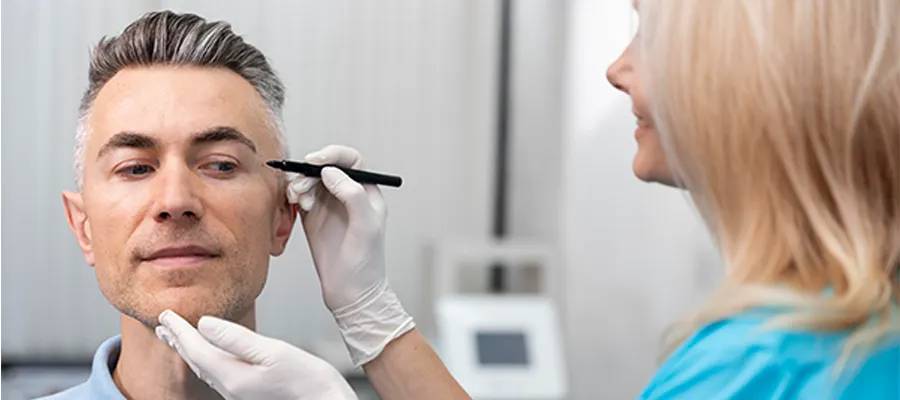
The procedure typically begins with facial assessment, surgical markings, and preparation for anesthesia. During endoscopic temporal lift surgery, concealed scalp incisions are created and a small camera is introduced to visualize the deeper tissue planes.