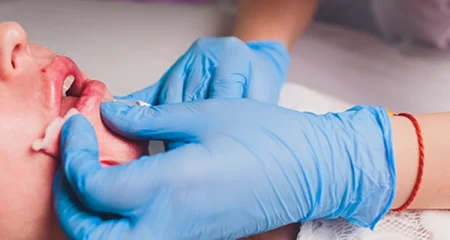


What Is Jaw Implant Surgery?
Jaw implant surgery is a facial augmentation procedure that uses specially shaped implants to increase projection, width, or definition along selected parts of the mandible. The procedure is most commonly used to strengthen a naturally weak jawline, enhance the mandibular angles, improve lower-face proportions, or address selected contour asymmetries.
Jaw implants change the structural framework beneath the facial soft tissues. They therefore differ from procedures that primarily remove fat, tighten skin, or lift jowls. In some patients, the most balanced result requires combining structural augmentation with chin or neck treatment.
The objective is not simply to make the jaw larger. Implant dimensions and placement should complement the chin, cheeks, facial width, and neck while preserving a natural transition across the lower face.
Understanding Jaw Structure and Lower-Face Proportions
The mandible forms much of the structural outline of the lower third of the face. Its width, height, projection, angle, and relationship with the chin strongly influence facial shape.
A narrow or underprojected mandible can create a weak lower-face appearance even in patients with little facial fat. Conversely, a wide jaw can make the lower face appear disproportionately dominant.
Soft tissues also matter. Skin thickness, facial fat, muscle volume, jowling, and neck anatomy influence how clearly the underlying mandible is visible.
Reasons for Choosing Jaw Implant Surgery
Patients may consider jaw implants when they want greater mandibular definition, wider lower-face proportions, stronger jaw angles, or correction of selected structural deficiencies.
Some people naturally have a relatively narrow or underdeveloped mandibular contour. Others seek better balance between a prominent upper or midface and a less projected lower face.
Jaw implant surgery may also be considered after temporary filler treatment when a patient wants more substantial or longer-lasting structural augmentation.
Ideal Candidates for Jawline Implant Enhancement
Suitable candidates generally have a skeletal contour deficiency that can reasonably be improved by adding volume around the mandible.
Good candidates should have stable general health, realistic expectations, and anatomy appropriate for implant placement.
Significant bite abnormalities, major skeletal asymmetry, or jaw-position problems may require maxillofacial evaluation rather than cosmetic implants alone. Patients with substantial jowling or loose neck skin may also require soft-tissue treatment to achieve adequate definition.
Improving a Weak or Underdeveloped Jaw with Implants
Jaw implants can strengthen a weak mandibular framework by increasing projection in strategically selected regions.
Depending on the design, implants may emphasize the jaw angles, mandibular body, or a broader portion of the lower jaw.
This structural augmentation can make the lower face appear stronger and improve separation between the jawline and neck. However, implants cannot directly remove fat or tighten loose tissues covering the mandible.
Jaw Implant Types, Shapes and Sizes
Jaw implants are available in different dimensions and configurations. Some focus mainly on increasing mandibular-angle projection, while others extend farther along the mandibular border.
Implants can vary in width, thickness, vertical height, and lateral projection. The appropriate design depends on the patient’s existing skeleton and desired lower-face shape.
In selected complex cases, customized implants may be considered to address specific anatomical requirements or asymmetry.
Enhancing the Mandibular Border with Jaw Implants
Mandibular border enhancement aims to create smoother structural continuity between the chin and jaw angles.
Implants can add projection where the underlying bone provides insufficient support. Extended designs may improve a longer segment of the mandibular contour rather than creating isolated prominence at the angles.
The transition between augmented and non-augmented areas is important. Poorly matched dimensions can create visible or palpable contour changes.
Creating a Sharper and More Defined Jawline
A stronger underlying framework can make the jawline appear sharper, particularly in patients with relatively thin soft tissues and good skin elasticity.
However, definition depends on more than bone projection. Excess submental fat, jowling, loose skin, and platysma laxity can continue obscuring the jaw even after structural augmentation.
For this reason, jaw implants sometimes form only one component of comprehensive lower-face contouring.
Improving Lower-Face Width and Facial Balance
Jaw implants can increase lower-face width, particularly when augmentation is concentrated around the mandibular angles.
This may improve balance in patients whose lower third appears disproportionately narrow relative to the cheekbones or upper face.
The amount of widening requires careful control. Excessive lateral projection can produce an unnaturally square or heavy appearance that does not suit the patient’s other facial features.
Correcting Jawline Asymmetry with Implants
Selected structural asymmetries may be improved using implants with different dimensions or customized designs.
One side may require greater projection or a differently shaped implant to create better visual balance.
Jaw asymmetry can also result from bite relationships, muscle size, facial fat, or broader skeletal differences. Implant augmentation is therefore not an appropriate solution for every asymmetric jaw.
Jaw Implant Placement and Surgical Techniques
Jaw implants are typically positioned directly over the mandibular bone within carefully created surgical pockets.
Access may be created through intraoral incisions depending on implant location and surgical technique. The surgeon then positions and stabilizes the implants according to the planned contour.
Accurate pocket creation is important because incorrect positioning can produce asymmetry, movement, or an unnatural mandibular outline.
Choosing the Right Jaw Implant for Natural-Looking Results
Natural-looking results depend on selecting an implant that complements existing facial anatomy.
The surgeon considers mandibular width, jaw-angle position, chin projection, cheekbone width, facial height, soft-tissue thickness, and neck contour.
Bigger implants are not automatically better. Subtle structural enhancement can produce a substantial visual difference when the implant dimensions correspond correctly with the patient’s proportions.
Jaw Implant Surgery for Men and Women
Jaw implant surgery should be customized according to anatomy and aesthetic goals rather than following rigid gender-based templates.
Some patients prefer broader and more angular mandibular contours, while others want subtle definition without substantially increasing lower-face width.
Existing facial shape remains important. An implant that creates attractive proportions in one patient can look excessive or insufficient in another.
Jaw Implants vs. Jawline Fillers
Jawline fillers provide non-surgical augmentation using injectable material. They can improve selected contour deficiencies without implant surgery.
Fillers are generally temporary and may require maintenance. Creating substantial jaw enlargement can also require considerable injectable volume.
Jaw implants provide more structural augmentation and are intended as a longer-lasting solution, but they require surgery and introduce implant-specific risks.
Jaw Implants vs. Fat Grafting
Fat grafting uses the patient’s own fat to increase soft-tissue volume around selected areas of the jaw.
It can produce smooth transitions and address multiple contour deficiencies, but some transferred fat is naturally resorbed. Fat also provides softer augmentation than a structural implant.
Jaw implants are generally better suited when stronger and more predictable skeletal-style projection is required.
Jaw Implant Surgery vs. Chin Implant Surgery
A chin implant primarily changes the front of the lower face, while jaw implants typically enhance the mandibular body, angles, or lateral jawline.
Chin augmentation can increase profile projection without significantly widening the posterior jaw. Jaw-angle implants can increase width and definition without adequately correcting a recessed chin.
Patients with deficiencies in both areas may benefit from a coordinated treatment strategy.
Combining Jaw and Chin Implants for Lower-Face Contouring
Jaw and chin implants can be combined when both anterior and lateral lower-face projection require improvement.
The chin implant strengthens the front of the mandibular contour, while jaw implants can enhance the sides and angles.
Careful planning is essential because augmenting several regions can significantly change facial width and volume. The implants should create a continuous mandibular outline rather than appearing as separate augmented areas.
Jaw Implant Surgery Prices 2026
Jaw Implant Surgery Prices 2026 vary considerably because the cost depends on the number, design, and type of implants required as well as the complexity of the planned lower-face augmentation.
Frequently Asked Questions
Jaw Implant Surgery with Neck and Jawline Contouring
Structural augmentation can be combined with neck and jawline contouring when soft tissues obscure the underlying mandibular framework.
Preparing for Jaw Implant Surgery
Preparation begins with detailed evaluation of the mandible, chin, facial width, symmetry, bite, soft tissues, and neck.Patients should disclose medical conditions, medications, supplements, allergies, nicotine use, dental problems, previous fillers, and earlier facial or jaw procedures.
Jaw Implant Surgery Recovery and Healing Process
Early recovery generally involves swelling, tightness, tenderness, bruising, and temporary changes in sensation.Swelling can initially make the lower face look substantially wider than the intended final result. This is particularly noticeable when both jaw angles are treated.
Swelling and Tightness After Jaw Implant Placement
Significant swelling is expected after implant placement and is usually most noticeable during the first several days.Visible swelling generally decreases progressively over the following weeks, although subtle fullness can remain for several months.
Returning to Work and Exercise After Jaw Implant Surgery
Return to work depends on the extent of surgery and how comfortable the patient is with visible swelling.Many patients may require approximately one to two weeks before returning to routine work, although residual swelling can remain noticeable beyond this period.
When Jaw Implant Results Look Natural
The structural change is visible early, but postoperative swelling initially hides the true implant contour.During the following weeks, facial width decreases as swelling resolves and the tissues begin adapting around the implants.
Longevity of Jaw Implant Surgery Results
Unlike temporary fillers, implants do not naturally dissolve according to a predetermined treatment interval. However, future revision or removal can occasionally become necessary because of complications, changing preferences, or anatomical changes.
Risks and Possible Complications of Jaw Implants
Potential complications include bleeding, hematoma, infection, delayed healing, altered sensation, nerve injury, implant displacement, asymmetrical positioning, palpability, contour irregularities, undercorrection, and overcorrection.