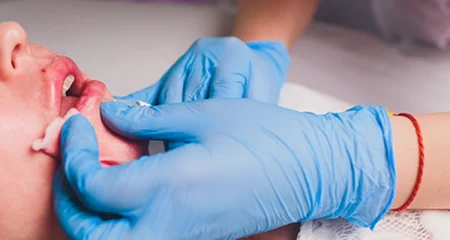


What Is Facial Implant Revision?
Facial implant revision is secondary surgery performed to remove, reposition, replace, resize, or otherwise correct a previously placed chin, jaw, cheek, or other facial implant. Revision may be considered because of implant displacement, asymmetry, infection, visible or palpable edges, an unsuitable implant size, changes in aesthetic preferences, or dissatisfaction with facial proportions.
Revision surgery is often more complex than primary facial implant placement because previous surgery can leave scar tissue and alter normal tissue planes. The surgeon must evaluate not only the existing implant but also the underlying bone, fixation, soft-tissue coverage, facial symmetry, and the patient’s current goals.
Some cases require a relatively limited implant adjustment, while others involve removal and replacement with a different standard or patient-specific implant.
Reasons for Revising a Previous Facial Implant
Patients consider implant revision for both medical and aesthetic reasons.
An implant may have shifted from its intended position, produced excessive projection, failed to provide enough augmentation, or created an unnatural transition with surrounding facial structures.
Revision can also become necessary because of infection, exposure, discomfort, changes in surrounding bone or soft tissue, or problems related to previous fixation. The reason for revision determines whether the implant should be repositioned, exchanged, or removed.
Signs That a Facial Implant May Need Correction
Potential signs include increasing asymmetry, a visible change in implant position, persistent discomfort, unusual mobility, prominent implant edges, or an unnatural facial contour.
Redness, drainage, progressive swelling, tenderness, fever, or implant exposure can indicate infection or another complication and require prompt medical assessment.
Not every early irregularity requires revision. Swelling and temporary asymmetry can occur during normal postoperative healing, so appropriate timing and examination are important before deciding on another operation.
Facial Areas Commonly Treated with Implant Revision
Revision surgery commonly involves implants placed in the chin, mandibular angles, jawline, or cheeks.
Chin implant revision may address projection, width, asymmetry, or displacement. Jaw implant revision can involve the mandibular body or angles, while cheek implant correction may focus on malar or submalar position.
Custom facial implants can also require revision if the desired proportions change or complications develop.
Ideal Candidates for Facial Implant Revision Surgery
Suitable candidates generally have a clearly identifiable implant-related concern that can reasonably be improved surgically.
The surgeon should determine whether the problem comes from implant design, position, fixation, surrounding scar tissue, underlying skeletal anatomy, or soft-tissue changes.
Patients should also understand that secondary surgery cannot always produce perfect symmetry. Previous operations may place limitations on what can safely and predictably be corrected.
Correcting Facial Implant Malposition and Shifting
Implant malposition occurs when an implant sits outside its intended anatomical position.
Depending on the situation, the surgeon may reposition the existing implant, modify the surgical pocket, change fixation, or replace the implant entirely.
Accurate correction requires identifying why displacement occurred. Simply returning an implant to its previous position may not solve the problem if an oversized pocket, unsuitable implant shape, or fixation issue remains.
Managing Facial Asymmetry After Implant Surgery
Facial asymmetry after implant placement can result from implant position, different skeletal anatomy on each side, unequal soft-tissue thickness, swelling, or pre-existing asymmetry.
Revision surgery may adjust implant position or use different implant dimensions to create better balance.
Three-dimensional imaging can be particularly helpful in complex cases because it allows the surgeon to distinguish skeletal asymmetry from implant-related differences.
Replacing an Implant That Is Too Large or Too Small
An oversized facial implant can produce excessive projection, width, or an artificial-looking contour.
An implant that is too small may provide inadequate correction or fail to create the intended facial proportions.
Revision surgery allows the implant dimensions to be reconsidered according to the current anatomy. A smaller, larger, differently shaped, or custom-designed implant may be selected depending on the problem.
Improving Unnatural Facial Contours After Implant Placement
Unnatural contours can occur when implant dimensions do not transition smoothly into the surrounding facial skeleton.
Visible edges, abrupt changes in projection, excessive jaw width, an overly projected chin, or disproportionate cheeks may become more noticeable after swelling completely resolves.
Revision planning should focus on the entire facial region rather than simply replacing one implant with another of a different size.
Facial Implant Removal vs. Implant Replacement
Implant removal eliminates the existing foreign material without necessarily replacing it.
This may be appropriate when a patient no longer wants augmentation, when infection requires removal, or when surrounding anatomy does not support immediate replacement.
Other patients still benefit from structural augmentation and may choose implant replacement. In selected cases, removal and replacement can occur during the same procedure; in others, healing may be required before another implant is placed.
Revising Chin Implants for Better Profile Balance
Chin implant revision can address excessive projection, insufficient projection, asymmetry, implant migration, visible edges, or an unsuitable implant shape.
The replacement implant should be selected according to chin width, jawline structure, lip position, nose projection, and overall profile.
Some patients initially treated with an implant may ultimately be better candidates for sliding genioplasty if the underlying problem requires skeletal repositioning rather than simple augmentation.
Jaw Implant Revision for Improved Lower-Face Definition
Jaw implant revision may involve implants along the mandibular border, jaw angles, or both.
Problems can include excessive lower-face width, inadequate definition, asymmetrical placement, displacement, or unnatural transitions between implanted and non-implanted areas.
Because bilateral jaw implants should work together as one continuous facial framework, even a relatively small positional difference can influence visible symmetry.
Cheek Implant Revision for Midface Symmetry
Cheek implant revision can correct malposition, excessive prominence, inadequate projection, asymmetry, or unnatural midface contours.
The surgeon evaluates both implant position and underlying cheekbone anatomy. Each side may require a different degree of correction when significant pre-existing skeletal asymmetry exists.
Replacement implants may emphasize malar, submalar, anterior, or lateral projection depending on the patient’s proportions.
Treating Implant-Related Infection and Complications
Facial implant infection requires careful evaluation because treatment depends on severity, implant type, location, timing, and surrounding tissue condition.
Some infections may require antibiotics and surgical management. Persistent or significant infection can require implant removal.
Immediate replacement is not appropriate in every infected case. The surgeon may recommend allowing inflammation and tissues to recover before considering another implant.
Correcting Scar Tissue Around Facial Implants
Previous surgery creates scar tissue around the implant and within the surgical pocket.
Scar tissue can make secondary dissection more difficult and may contribute to tightness, irregularity, or changes in implant position.
During revision, selected scar tissue may need to be released or modified. However, aggressive removal can also damage surrounding tissues, making controlled dissection particularly important.
Custom Implants for Secondary Facial Implant Surgery
Custom implants can be useful in complex facial implant revision when standard implant dimensions do not adequately match altered anatomy.
CT-based planning can allow an implant to be designed around the patient’s current skeletal surface. This can be valuable after previous augmentation, bone surgery, trauma, or significant asymmetry.
Custom design does not eliminate surgical risk. Accurate positioning, fixation, soft-tissue coverage, and appropriate dimensions remain essential.
Facial Implant Revision vs. Non-Surgical Correction
Minor contour differences can sometimes be camouflaged with non-surgical treatments such as appropriately selected fillers or fat grafting.
These approaches do not correct a significantly displaced, infected, oversized, or structurally unsuitable implant.
Adding injectable volume around a poorly positioned implant may also create additional bulk rather than solving the underlying problem. Structural implant complications generally require surgical assessment.
Combining Implant Revision with Facial Contouring
Implant revision can sometimes be combined with bone contouring, fat grafting, liposuction, facelift surgery, neck contouring, or other procedures.
For example, replacing an oversized jaw implant may be accompanied by refinement of surrounding skeletal contours. Fat grafting can sometimes soften transitions when soft-tissue coverage is limited.
Combined treatment should be based on specific anatomical needs rather than routinely adding procedures during revision surgery.
Planning Revision Surgery Around Existing Facial Anatomy
Revision planning begins with understanding exactly what was done previously.
The surgeon evaluates implant type, dimensions, location, fixation, surrounding bone, scar tissue, and facial soft tissues. Previous operative reports and implant information can be extremely useful when available.
CT or three-dimensional imaging may help establish the exact position of existing implants and their relationship with the underlying skeleton.
Preparing for Facial Implant Revision Surgery
Preparation may include medical evaluation, standardized photography, facial imaging, previous surgical-record review, and anesthesia assessment.
Patients should provide information about previous implants, implant materials, fixation methods, facial surgery, fillers, fat grafting, infections, medications, allergies, supplements, and nicotine use.
When intraoral surgery is anticipated, dental and oral health may also require assessment before the procedure.
Facial Implant Revision Prices 2026
Facial Implant Revision Prices 2026 vary widely because revision can range from a relatively limited repositioning procedure to removal and reconstruction involving several custom facial implants
Frequently Asked Questions
Facial Implant Revision Recovery and Healing Stages
Recovery depends on whether the implant is simply repositioned, removed, replaced, or combined with additional surgery.
Swelling, bruising, tenderness, tightness, and temporary numbness can occur during early
Swelling and Tightness After Implant Revision
Swelling is generally greatest during the first several days and progressively decreases during the following weeks.Tightness can result from postoperative swelling, surgical pocket modification, and adaptation of soft tissues around the revised implant.
Returning to Work and Normal Activities After Revision Surgery
Return to work depends on implant location, surgical extent, and the amount of visible swelling.Some patients undergoing relatively limited revision may return to desk-based work within approximately one to two weeks, while more extensive jaw, cheek, or multi-implant revision can require longer.
When Facial Implant Revision Results Look Natural
Initial improvement may be visible once early swelling begins decreasing, but revised facial contours continue changing during healing.Chin revision may settle differently from extensive jaw or cheek implant surgery. Complex procedures can require several months before subtle swelling, firmness, and tissue adaptation resolve.
Longevity of Revised Facial Implant Results
Successfully revised facial implants are generally intended to provide long-term structural augmentation.There is no universal expiration date requiring all facial implants to be routinely replaced after a specific number of years.
Risks and Possible Complications of Facial Implant Revision
Facial implant revision surgery carries general surgical risks as well as challenges related to previous operations.Potential complications include bleeding, hematoma, infection, delayed healing, persistent swelling, altered sensation, nerve injury, implant displacement, asymmetry, visible or palpable edges, contour irregularities, and dissatisfaction with implant size or projection.