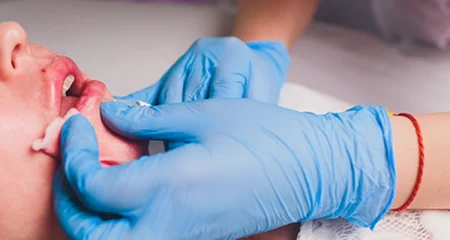


What Is Cheek Implant Surgery?
Cheek implant surgery is a facial augmentation procedure that uses specially shaped implants to increase cheek projection, strengthen the cheekbone contour, or improve structural volume in the midface. Depending on implant position and design, surgery can enhance the malar region over the cheekbones, the submalar region below them, or a combination of these areas.
Cheek augmentation is primarily a structural procedure. It differs from a facelift or midface lift, which repositions descended tissues, and from fat grafting or fillers, which increase soft-tissue volume.
Successful cheek implant surgery should improve facial proportions without making the midface look excessively wide, prominent, or artificial.
Understanding Cheek Projection and Midface Contours
Cheek projection plays an important role in facial shape because the cheekbones form a major structural transition between the eyes and lower face.
Midface appearance depends on the underlying zygomatic bones, facial fat compartments, skin thickness, and position of the surrounding soft tissues.
Some people naturally have limited cheekbone projection, while others lose midface volume with age. Determining whether the concern is skeletal deficiency, volume loss, or tissue descent helps identify the most appropriate treatment.
Reasons for Choosing Cheek Implant Surgery
Patients may choose cheek implants to increase naturally limited cheek projection, create stronger cheekbone definition, improve facial proportions, or address selected asymmetries.
Some patients prefer implants because they want more structural augmentation than fillers or fat transfer can provide.
Cheek implants may also complement other facial procedures. Increasing midface projection can change the perceived relationship between the cheeks, nose, chin, and jawline.
Facial Features That Can Benefit from Cheek Augmentation
Cheek augmentation can be useful when the midface appears flat, narrow, poorly projected, or structurally disproportionate to the rest of the face.
Patients with limited malar projection may notice insufficient definition beneath the eyes or through the upper cheeks.
However, not every hollow or aged cheek requires an implant. Age-related fat loss and descended soft tissues may be better treated through fat grafting, lifting, or combined rejuvenation techniques.
Ideal Candidates for Cheek Implant Surgery
Suitable candidates generally have a stable structural deficiency that can be improved through permanent or long-term augmentation.
Candidates should be in suitable general health and have realistic expectations about facial changes. Skin thickness, existing cheek projection, facial width, asymmetry, and previous procedures should be considered.
Patients primarily affected by substantial midface descent may require lifting rather than simply adding an implant beneath descended tissues.
Cheek Implant Types, Shapes and Sizes
Cheek implants are available in multiple shapes and degrees of projection.
Some designs concentrate augmentation over the malar eminence, creating stronger cheekbone projection. Others extend into the submalar area to add volume below the cheekbone.
Implant width, thickness, projection, and extension should correspond to the patient’s facial skeleton. Selected patients with complex anatomy may be considered for customized implant designs.
Enhancing Flat or Underdeveloped Cheeks with Implants
Flat cheeks may result from naturally limited projection of the underlying zygomatic structure.
An implant can increase structural support beneath the soft tissues and create greater anterior or lateral cheek projection depending on its design and placement.
The objective should be sufficient augmentation to improve the midface without making the cheeks disproportionately dominant relative to the forehead, nose, and lower face.
Restoring Midface Volume and Facial Balance
Cheek implants can increase midface fullness, but structural augmentation and volume restoration are not always the same objective.
An implant provides a defined underlying framework. Fat grafting can instead distribute softer volume across several areas affected by age-related deflation.
When both skeletal deficiency and soft-tissue volume loss are present, a surgeon may consider combining techniques rather than relying on an excessively large implant.
Creating More Defined Cheekbones with Cheek Implants
Malar implants can strengthen the visible prominence of the cheekbones.
The effect depends on whether projection is increased anteriorly, laterally, or in both directions. This can influence facial width and the contour extending from the lower eyelid toward the lateral cheek.
A natural result should blend gradually into surrounding tissues rather than producing an abrupt or obviously implanted cheek contour.
Improving Facial Symmetry Through Cheek Augmentation
Cheek augmentation can improve selected asymmetries when one side has less skeletal projection than the other.
Different implant dimensions or customized designs may sometimes be used to compensate for anatomical differences.
However, asymmetry can also originate from the jaw, orbital structures, soft tissues, or broader craniofacial anatomy. Cheek implants cannot correct every form of facial asymmetry.
Cheek Implant Placement and Surgical Techniques
Cheek implants are commonly inserted through carefully planned incisions, frequently using intraoral access depending on the technique and implant position.
The surgeon creates a pocket over the facial skeleton and positions the implant according to the preoperative plan. Fixation may be used depending on implant design and surgical preference.
Precise pocket creation is important because implant position directly influences symmetry, projection, and long-term contour.
Choosing the Right Cheek Implant for Natural-Looking Results
Choosing the correct implant requires analysis of facial width, cheekbone projection, orbital relationships, midface height, skin thickness, and lower-face proportions.
The implant should complement rather than compete with existing features.
Excessively large implants can make the midface look unnaturally wide or prominent. Conversely, insufficient projection may produce little meaningful improvement despite undergoing surgery.
Malar vs. Submalar Cheek Implants
Malar implants primarily augment the cheekbone region and can create greater skeletal definition or projection.
Submalar implants focus more on the area beneath the cheekbone and can add fullness to a relatively deficient midface.
Some implant designs combine both regions. Selection depends on whether the patient’s concern involves skeletal cheekbone prominence, volume below the cheek, or a combination of anatomical deficiencies.
Cheek Implants vs. Dermal Fillers
Dermal fillers can temporarily increase cheek volume without surgery. They allow flexible placement and can be useful for patients seeking modest augmentation.
Cheek implants provide more substantial structural projection and do not require routine injectable maintenance. However, they require surgery and carry implant-related risks.
Large amounts of filler should not automatically be used to reproduce the effect of an implant, particularly when significant skeletal augmentation is required.
Cheek Implants vs. Facial Fat Grafting
Facial fat grafting uses the patient’s own tissue to restore volume in selected midface areas.
Fat can create softer, more diffuse augmentation and is particularly useful when volume loss extends beyond the cheekbone. Some transferred fat, however, is naturally resorbed during healing.
Cheek implants provide more predictable structural projection. Fat grafting and implants can sometimes be combined when both skeletal and soft-tissue deficiencies exist.
Cheek Implant Surgery vs. Midface Lift
Cheek implants add structural projection, whereas a midface lift repositions descended cheek tissues.
A patient with naturally flat cheekbones but minimal tissue descent may benefit from augmentation. Someone with adequate skeletal projection but age-related cheek descent may benefit more from lifting.
When both problems exist, structural augmentation and tissue repositioning can potentially be combined following individualized assessment.
Cheek Implant Surgery Prices 2026
Cheek Implant Surgery Prices 2026 vary according to implant type, number of implants, degree of augmentation, surgical complexity, anesthesia, surgeon experience, facility charges, and geographic location. Standard bilateral cheek augmentation will generally have a different cost from customized implant surgery designed to address substantial asymmetry or complex skeletal anatomy.
Frequently Asked Questions
Combining Cheek Implants with Chin and Jawline Contouring
Cheek implants can be combined with chin or jawline procedures when several facial thirds require structural balancing.Increasing cheek projection can strengthen the midface, while chin and jaw augmentation can improve the lower-face framework.
Cheek Implant Surgery with Facelift or Neck Lift Procedures
Cheek augmentation may be performed alongside a facelift when structural midface deficiency coexists with age-related tissue descent.The facelift repositions sagging tissues, while the implant provides underlying projection. Facial fat grafting may also be considered for additional volume restoration.
Preparing for Cheek Implant Surgery
Patients should disclose medications, supplements, allergies, medical conditions, nicotine exposure, dental concerns, previous fillers, fat grafting, and facial surgery.Preoperative requirements may include photographs, imaging in selected cases, laboratory testing, anesthesia assessment, medication instructions, and fasting. Good oral health can be particularly relevant when intraoral access is planned.
Cheek Implant Recovery and Healing Stages
The cheeks may initially look substantially larger than intended because postoperative swelling temporarily adds to the implant projection.Over the following weeks, visible swelling decreases and the implants begin to blend more naturally with surrounding tissues. Deeper healing continues for several months.
Swelling and Tightness After Cheek Augmentation
Unequal swelling may temporarily make one cheek appear larger. Increasing redness, severe pain, drainage, fever, sudden swelling, or an obvious change in implant position should be medically evaluated.
Returning to Work and Exercise After Cheek Implant Surgery
Strenuous exercise and activities that could cause facial impact generally require a longer restriction period. Recovery may also be longer when cheek augmentation is combined with facelift, rhinoplasty, or other facial surgery.
When Cheek Implant Results Begin to Look Natural
The tissues continue adapting around the implants over subsequent months. A more mature, natural-looking cheek contour is therefore evaluated after sufficient swelling and firmness have resolved.
Longevity of Cheek Implant Surgery Results
They do not generally require routine replacement solely because a predetermined number of years has passed. However, complications, changing aesthetic preferences, displacement, or other concerns can occasionally require future revision or removal.
Risks and Possible Complications of Cheek Implants
Potential complications include infection, bleeding, hematoma, delayed healing, altered sensation, nerve irritation or injury, asymmetry, implant displacement, palpability, visible implant edges, contour irregularities, undercorrection, and overcorrection.