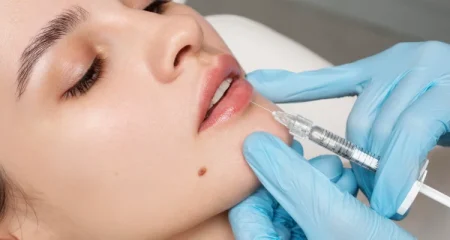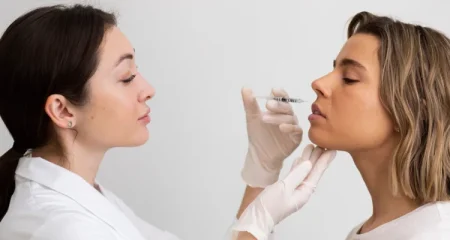


What Is Lip Fat Grafting?
Using a person’s own fat to increase lip volume is a surgical form of autologous soft-tissue augmentation. During Lip Fat Grafting, a small amount of fat is harvested from another body area, processed, and carefully injected into selected regions of the lips.
Unlike temporary fillers, transferred fat consists of living tissue. Some grafted fat cells can establish a blood supply and remain long term, while another portion is naturally absorbed during healing.
The procedure can increase volume, improve selected contour differences, or restore tissue lost through aging, trauma, or previous treatment. Both the upper and lower lips can be treated according to individual proportions.
Results are less predictable than simply measuring the amount injected because graft survival varies. Lip movement, tissue quality, harvesting technique, processing, injection method, and individual healing can all influence the final retained volume.
Why Is Fat Used for Lip Augmentation?
Autologous fat provides volume using tissue obtained from the same person rather than a manufactured injectable material. When appropriate anatomy and donor tissue are available, Lip Fat Grafting can create soft augmentation while avoiding the need for a permanent synthetic implant.
Fat also contains a mixture of mature fat cells and other cellular components naturally present in adipose tissue. However, the main predictable purpose of treatment is volume restoration rather than guaranteed tissue regeneration.
Transferred fat behaves differently from temporary fillers. Cells that successfully establish a blood supply may remain for an extended period, while non-surviving cells are gradually absorbed.
The technique also allows surgeons to distribute small amounts across selected lip areas. Careful placement is important because excessive injection can create irregularity, asymmetry, or disproportionate fullness.
Who May Consider Lip Fat Grafting?
People seeking autologous lip augmentation may consider fat transfer when they have naturally limited volume, age-related thinning, asymmetry, or selected soft-tissue deficiencies. For suitable candidates, Lip Fat Grafting can provide volume using fat harvested from another body area.
Enough accessible donor fat must be available, although lip augmentation generally requires much less tissue than larger-volume fat-transfer procedures. Overall health and realistic expectations are also important.
Previous lip filler, surgery, trauma, or scarring can influence treatment planning. Altered tissue planes may affect how evenly transferred fat can be distributed.
Candidates should understand that not every injected fat cell survives. Early postoperative fullness is therefore not the final result, and additional treatment may sometimes be considered after healing if retained volume is lower than desired.
What Lip Concerns Can Fat Grafting Improve?
Reduced volume, age-related thinning, mild asymmetry, and selected soft-tissue deficiencies can potentially improve with autologous fat transfer. Depending on the cause, Lip Fat Grafting may add fullness to the upper lip, lower lip, or targeted areas requiring additional support.
The technique can also be considered when volume has been lost following trauma or previous procedures. However, significant scar contraction or structural distortion may require additional treatment beyond volume replacement.
Fat does not correct every lip concern. A long philtrum, markedly downturned mouth corners, significant tissue excess, or substantial lip-position problems may require different approaches.
Treatment planning should therefore identify whether the main problem involves volume, position, shape, or movement. Adding fat to a structural problem without addressing its cause may produce limited improvement.
Lip Fat Grafting for Naturally Thin Lips
Naturally thin lips may have limited volume, reduced projection, or relatively little visible fullness compared with surrounding facial features. When augmentation is desired, Lip Fat Grafting can add autologous tissue while maintaining individualized upper-to-lower lip proportions.
Small amounts of processed fat can be distributed through selected areas rather than creating uniform enlargement. This allows treatment to focus on regions where additional fullness is needed.
The final increase depends partly on graft survival. Some transferred fat is expected to be absorbed, meaning the early postoperative appearance may be fuller than the eventual result.
Naturally thin anatomy also places limits on augmentation. Excessive volume can distort normal contours or overwhelm the surrounding facial proportions, so gradual and conservative enhancement may be preferable.
Lip Fat Grafting for Age-Related Volume Loss
Aging can gradually reduce lip fullness while changing skin elasticity, vermilion appearance, dental support, and surrounding soft tissues. When loss of volume is an important component, Lip Fat Grafting may restore selected fullness using the patient’s own adipose tissue.
Treatment can be distributed differently across the upper and lower lips according to where volume has decreased. The objective is usually restoration rather than excessive enlargement.
Fat transfer does not correct every feature of perioral aging. Lip elongation, wrinkles, mouth-corner descent, dental changes, and skin laxity can remain even after volume has been restored.
Facial aging also continues after treatment. Surviving fat may remain long term, but surrounding tissues can continue changing, meaning the appearance of the lips may evolve over time.
Lip Fat Grafting for Uneven Lip Volume
Differences in fullness between the two sides can arise naturally or develop after trauma, surgery, aging, or previous cosmetic treatment. When insufficient volume contributes to the imbalance, Lip Fat Grafting may add targeted tissue to the smaller or less projected area.
Treatment does not necessarily require equal injection on both sides. Different volumes can be placed according to existing anatomy and the desired degree of correction.
Not all asymmetry comes from volume. Muscle activity, nerve function, scar contraction, dental relationships, and skeletal differences can also make the lips appear uneven.
Because graft survival itself can vary between treated areas, perfect symmetry cannot be guaranteed. Final balance should be assessed after swelling has resolved and transferred tissue has stabilized.
Lip Fat Grafting for Soft-Tissue Deficiency
Soft-tissue deficiencies can develop after trauma, surgery, congenital differences, scarring, or localized tissue loss. In selected cases, Lip Fat Grafting can restore volume where the lips or immediately surrounding tissues lack adequate soft-tissue support.
Scarred areas may respond differently from untreated tissue because blood supply and tissue flexibility can be altered. These characteristics can influence both injection technique and graft survival.
Several treatment sessions may occasionally be considered when the deficiency is substantial or when conservative staged correction is preferred. Each session should be evaluated after adequate healing.
Fat transfer cannot replace every missing anatomical structure. Significant muscle injury, major tissue loss, or structural deformity may require reconstructive techniques in addition to volume restoration.
How Donor Fat Is Selected for Lip Enhancement
Suitable donor tissue should provide enough accessible fat for harvesting while allowing the collection procedure to remain proportionate to the required volume. Because the lips need relatively small amounts, Lip Fat Grafting does not usually require extensive donor-area fat removal.
Donor selection can depend on body composition, previous procedures, scar locations, and the accessibility of potential harvesting areas. The quality and handling of the collected tissue are also important considerations.
No donor location guarantees superior long-term survival in every patient. Harvesting technique, processing, injection, recipient-site conditions, and individual biology can all influence graft retention.
The donor area should therefore be selected according to the complete treatment plan rather than assuming one body region always produces better lip results.
Common Donor Areas for Lip Fat Grafting
Small volumes of fat can be harvested from several body regions depending on individual anatomy. Common possibilities for Lip Fat Grafting include the abdomen, flanks, thighs, hips, or other areas containing accessible subcutaneous fat.
The selected region does not need to contain a large fat deposit because lip augmentation requires relatively limited volume. Lean individuals may still have suitable donor tissue, although availability varies.
Previous liposuction or surgery can influence which area is practical for harvesting. Existing scars and irregularities should also be considered.
Donor-site expectations are important because harvesting can cause temporary swelling, tenderness, and bruising. Removing a small amount for lip treatment should not be assumed to provide the same body-contouring effect as a dedicated liposuction procedure.
How Fat Is Harvested for Lip Injection
Fat is typically collected through small access points using controlled suction and a cannula. During Lip Fat Grafting, harvesting aims to obtain viable adipose tissue while minimizing unnecessary trauma to cells that may later be transferred.
Collected material is then prepared to separate usable fat from unwanted fluid, oil, blood, or debris. Processing methods can vary according to technique.
The prepared tissue is transferred into small syringes for controlled placement within the lips. Small deposits are generally distributed through multiple tissue planes rather than injecting one large collection in a single location.
Careful handling matters because transferred cells need access to blood supply at the recipient site. Overfilling one area can reduce predictability and increase the possibility of irregular contours or uneven survival.
Revision Options After Lip Fat Grafting
Secondary treatment may be considered when retained volume is insufficient, asymmetrical, excessive, or irregular after complete healing. Depending on the problem, revision of Lip Fat Grafting can involve additional fat transfer, targeted contour correction, or another treatment suited to the underlying concern.
Insufficient volume may result from greater-than-expected graft absorption. Once the retained result has stabilized, another conservative transfer can sometimes add further fullness.
Excessive or irregular volume can be more complicated to correct because surviving fat becomes living tissue within the recipient area. Treatment depends on the location and extent of the problem.
Early swelling should not be confused with a final contour issue. Adequate healing time allows inflammation to decrease and graft survival to stabilize before revision decisions are made.
Lip Fat Grafting Prices 2026
Treatment cost varies because the procedure includes both fat harvesting and lip augmentation. During 2026, pricing for Lip Fat Grafting may depend on donor-area selection, harvesting complexity, processing method, treatment extent, anesthesia, and whether previous lip procedures have altered the anatomy.
Frequently Asked Questions
Is lip fat grafting permanent?
Some transferred fat can survive long term after establishing an adequate blood supply in the recipient tissue. For this reason, successful Lip Fat Grafting can provide more durable volume than temporary injectable fillers.
Not all transferred cells survive, and a portion of the initial volume is normally lost during healing. Surviving fat can also respond to aging and significant weight changes like other living fat tissue.
Where is the fat taken from for lip fat grafting?
Donor tissue can come from areas containing accessible subcutaneous fat, commonly including the abdomen, thighs, flanks, or hips. For Lip Fat Grafting, only a relatively small amount is generally required compared with larger-volume fat-transfer procedures.
The most appropriate donor area depends on individual body composition, previous surgery, scars, and harvesting considerations rather than one universally preferred location.
How much fat survives after lip fat transfer?
No single survival percentage applies reliably to every patient because graft retention varies with tissue handling, injection technique, blood supply, recipient-site conditions, and individual healing. Following Lip Fat Grafting, some transferred cells survive while others are gradually absorbed.
Early lip volume therefore should not be interpreted as the final result. Swelling and temporary overfullness must resolve before long-term retained volume can be evaluated.
Do fat-grafted lips feel natural?
Successfully integrated fat becomes part of the surrounding soft tissue and can produce a relatively soft, natural-feeling result. After Lip Fat Grafting has fully healed, the transferred tissue should not normally feel like a separate solid implant.
Temporary firmness and swelling can occur during recovery. Scar tissue, uneven graft distribution, or previous procedures may influence texture, so individual results can vary.
Can lip fat grafting create subtle lip volume?
Conservative treatment can provide relatively modest enhancement when small amounts of fat are carefully distributed according to existing anatomy. With appropriately planned Lip Fat Grafting, the objective can be subtle volume restoration rather than dramatic enlargement.
Final volume remains less precisely predictable than the amount initially injected because some fat is absorbed. For this reason, natural-looking results depend on conservative planning, balanced placement, and adequate healing time.