

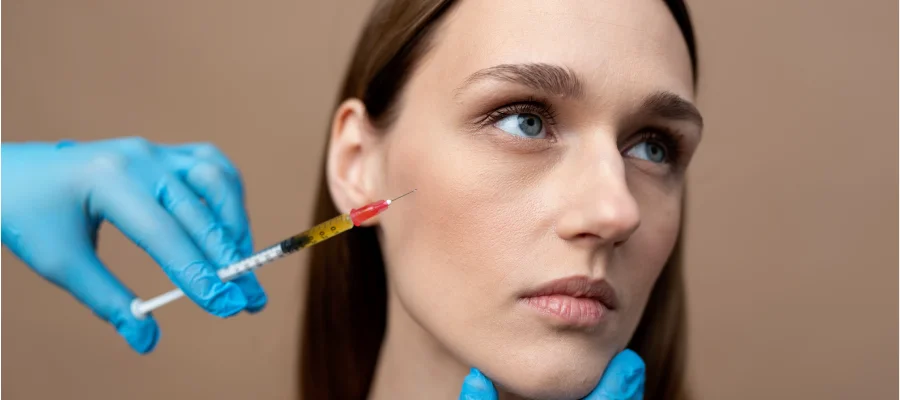
What Is Polynucleotide / Salmon DNA Facial Treatment?
Polynucleotide treatment is an injectable aesthetic approach designed to support skin quality, hydration, texture, and elasticity. In aesthetic medicine, Polynucleotide / Salmon DNA Facial Treatment commonly refers to purified polynucleotide-based injectable preparations derived from fish DNA sources, including salmon or trout depending on the product.
These preparations are injected into selected superficial tissue layers rather than used primarily to create facial volume. Their intended role is generally related to skin conditioning and tissue-quality improvement.
Results vary according to the formulation, treatment area, age, baseline skin condition, and number of sessions. The terms “salmon DNA” and “polynucleotide” are sometimes used broadly in marketing, so the exact composition and regulatory status of the injectable product should always be considered.
How Do Polynucleotides Work in Facial Skin Treatments?
Polynucleotides are chains of nucleotides that can be formulated for injectable aesthetic applications. During Polynucleotide / Salmon DNA Facial Treatment, small amounts of the preparation are placed into selected areas to support the skin’s local tissue environment.
Proposed effects include improved hydration and support for processes involved in extracellular matrix and tissue remodeling. Laboratory and clinical research has also explored effects involving fibroblast activity and oxidative stress, although results should not be interpreted as guaranteed regeneration.
Polynucleotide treatments generally aim to improve skin quality gradually rather than immediately add significant volume. The response depends on product characteristics, injection technique, treatment frequency, and individual biology.
Evidence and approved indications can vary between formulations and countries, so different polynucleotide products should not automatically be considered equivalent.
What Is Salmon DNA in Skin Rejuvenation?
“Salmon DNA” is a commonly used term for aesthetic preparations containing purified DNA-derived components obtained from fish sources. In many aesthetic discussions, Polynucleotide / Salmon DNA Facial Treatment describes injectable products containing polynucleotides or related DNA fragments.
The material undergoes purification and processing before being formulated for medical or aesthetic use. It should not be understood as untreated salmon DNA being directly injected into the skin.
These treatments are generally intended to support hydration, texture, elasticity, and overall skin appearance rather than provide substantial facial augmentation.
Terminology can vary between products. For this reason, patients should consider the actual formulation and intended use rather than assuming every treatment described as “salmon DNA” contains identical ingredients or produces identical results.
What Is the Difference Between Polynucleotides and Skin Boosters?
Polynucleotides and skin boosters can both target skin quality, but their ingredients and intended mechanisms may differ. While many traditional skin boosters rely primarily on hyaluronic acid, Polynucleotide / Salmon DNA Facial Treatment uses purified nucleotide-based preparations.
Hyaluronic acid skin boosters are generally associated with improving skin hydration and smoothness through their water-binding properties. Polynucleotide treatments are intended to support the tissue environment and gradual skin-quality changes.
Neither category should automatically be considered better. The appropriate option depends on whether the main concern involves dehydration, texture, elasticity, fine lines, or several combined factors.
Some treatment plans may use both approaches at different times. Product characteristics and regulatory indications should guide treatment selection.
Which Skin Concerns Can Be Addressed with Polynucleotide Treatment?
Polynucleotide injections may be considered for mild textural changes, dehydration, fine lines, reduced elasticity, and generally tired-looking skin. For appropriate candidates, Polynucleotide / Salmon DNA Facial Treatment aims to improve overall skin quality rather than significantly change facial shape.
The treatment may be particularly relevant when early aging changes affect thin or delicate skin. However, it cannot correct every aesthetic concern.
Deep wrinkles, substantial skin laxity, pronounced facial volume loss, and deep acne scars generally require other or additional treatments. Pigmentation problems may also need specifically targeted therapies.
The treatment plan should therefore identify the main cause of the concern. Realistic goals focus on gradual improvement in skin appearance rather than dramatic lifting or structural transformation.
Who Is a Suitable Candidate for Salmon DNA Facial Treatment?
Suitable candidates are generally adults seeking gradual improvement in skin quality without substantial facial volumization. In selected individuals, Polynucleotide / Salmon DNA Facial Treatment may be considered for early fine lines, mild dehydration, textural changes, or reduced skin elasticity.
Treatment suitability depends on medical history, allergies, skin condition, and the specific injectable formulation. Active infection or significant inflammation around the intended injection area may require treatment to be postponed.
People with known sensitivities to components of a particular preparation also require careful assessment. Pregnancy, breastfeeding, medications, and relevant medical conditions should be discussed before injectable treatment.
Expectations are equally important because polynucleotide treatment generally produces subtle, progressive changes rather than immediate structural correction.
Polynucleotide Treatment for Fine Lines and Skin Texture
Fine lines and mild textural irregularities can become more noticeable as hydration and skin quality change with age. In suitable patients, Polynucleotide / Salmon DNA Facial Treatment may support gradual improvements that create a smoother and more refined skin appearance.
This treatment is generally better suited to superficial skin-quality concerns than deep wrinkles, significant volume loss, or advanced skin laxity. Deeper acne scars and other structural texture problems may require additional treatments such as subcision, microneedling, resurfacing, or combination therapy.
Factors that influence improvement in fine lines and skin texture include:
- Degree of fine lines
- Skin hydration
- Overall skin quality
- Type of textural irregularity
- Depth of wrinkles
- Presence of volume loss
- Degree of skin laxity
- Presence of acne scars
- Treatment area
- Product formulation
- Number of treatment sessions
- Individual treatment response
- Need for combination treatments
Can Polynucleotides Be Used for Under-Eye Rejuvenation?
Selected polynucleotide formulations can be used in the under-eye area when the goal is to improve thin skin and fine superficial lines. Polynucleotide / Salmon DNA Facial Treatment should be performed conservatively in this region because the tissues around the eyes are delicate.
Polynucleotides are not primarily intended to replace substantial lost volume. Pronounced tear troughs, eye bags, pigmentation, or significant skin laxity may require different approaches depending on their underlying cause.
Factors considered during under-eye polynucleotide treatment include:
- Under-eye skin thickness
- Fine superficial lines
- Degree of volume loss
- Presence of tear troughs
- Prominence of eye bags
- Skin pigmentation
- Degree of skin laxity
- Product selection
- Injection depth
- Amount of product used
Which Areas of the Face Can Be Treated?
Several facial regions may be considered when the primary goal is improving skin quality. Depending on the specific formulation, Polynucleotide / Salmon DNA Facial Treatment can be applied to areas such as the cheeks, forehead, lower face, perioral region, and selected areas around the eyes.
The treatment may also be extended to the neck or other areas with similar skin-quality concerns when appropriate.
Each anatomical area requires different injection depths and quantities. Thin under-eye skin, for example, should not be approached in the same way as thicker cheek tissue.
The exact treatment map should therefore reflect skin thickness, sensitivity, visible concerns, and product characteristics rather than using identical injections throughout the face.
What Happens During a Polynucleotide Facial Treatment Session?
A treatment session generally begins with cleansing and assessment of the planned injection areas. During Polynucleotide / Salmon DNA Facial Treatment, small quantities of the selected preparation are introduced through multiple fine injections.
A topical anesthetic may be applied beforehand to improve comfort. Injection depth and spacing vary according to the product, anatomical area, and treatment objective.
Small raised bumps can temporarily appear where the material was injected. Redness, mild swelling, tenderness, or bruising may also occur immediately afterward.
Treatment time varies according to the number of areas involved. Most patients can return to routine activities relatively quickly, although visible injection marks or swelling may remain temporarily.
How Many Polynucleotide Treatment Sessions Are Usually Needed?
The number of sessions varies according to the product, baseline skin condition, treatment area, and desired degree of improvement. Rather than relying on one injection appointment, Polynucleotide / Salmon DNA Facial Treatment is commonly planned as an initial series followed by reassessment.
Some protocols use several sessions separated by a few weeks. However, there is no universal schedule that applies to every formulation or patient.
Gradual changes may continue developing during the treatment course. Once the initial series is completed, maintenance sessions may sometimes be considered depending on how long the effects remain noticeable.
Treatment frequency should follow the characteristics of the specific product and the individual’s response rather than an unnecessarily intensive schedule.
Recovery and Aftercare After Salmon DNA Treatment
Recovery is generally relatively short, although temporary injection-related effects should be expected. Following Polynucleotide / Salmon DNA Facial Treatment, small bumps, redness, tenderness, swelling, or bruising may develop around injection sites.
These effects usually decrease gradually. Swelling can sometimes be more noticeable when the delicate under-eye region has been treated.
Patients are generally advised to avoid rubbing or placing unnecessary pressure on freshly injected areas. Gentle skincare and appropriate sun protection can also support recovery.
Increasing pain, significant warmth, spreading redness, drainage, or unexpectedly severe swelling should be medically evaluated because these findings may indicate a complication rather than routine post-injection recovery.
When Do Polynucleotide Treatment Results Become Visible?
Polynucleotide results generally develop gradually rather than immediately. After initial injection-related swelling settles, improvements associated with Polynucleotide / Salmon DNA Facial Treatment may become noticeable over the following weeks.
Early changes may include a more hydrated or refreshed appearance. Improvements in texture, fine lines, and general skin quality can take longer and may become more apparent after several sessions.
The speed of response varies according to age, skin condition, treatment area, formulation, and individual biology.
Immediate fullness caused by injection swelling should not be confused with the final result. The treatment is primarily intended for progressive skin-quality improvement rather than instant facial volumization.
How Long Do Polynucleotide Facial Treatment Results Last?
The duration of visible improvement varies between individuals and treatment protocols. After completing Polynucleotide / Salmon DNA Facial Treatment, results may gradually decrease as normal aging and environmental influences continue affecting the skin.
Factors such as sun exposure, smoking, skincare, age, baseline skin quality, and the number of sessions can influence longevity. Different polynucleotide formulations may also have different treatment and maintenance schedules.
Results should therefore not be considered permanent. Periodic maintenance sessions may be recommended when appropriate.
Long-term skin quality also depends on daily habits. Consistent sun protection and suitable skincare can complement professional treatments but cannot permanently prevent natural aging.
Polynucleotide / Salmon DNA Facial Treatment Prices 2026
Treatment costs vary according to the specific injectable formulation, quantity used, treatment area, and number of sessions. When calculating Polynucleotide / Salmon DNA Facial Treatment prices, the initial treatment course and possible maintenance requirements should both be considered.
Frequently Asked Questions
Is Salmon DNA the same as polynucleotide treatment?
The terms are often used together, but they are not always technically interchangeable. In aesthetic practice, Polynucleotide / Salmon DNA Facial Treatment can refer to purified nucleotide-based preparations derived from fish DNA sources. Exact composition varies between products, so the formulation should always be checked.
What does polynucleotide treatment do for the face?
The main goal is to support hydration, texture, elasticity, and general skin quality without creating substantial facial volume. For suitable patients, Polynucleotide / Salmon DNA Facial Treatment may provide gradual improvement in fine superficial lines and tired-looking skin.
Can Salmon DNA treatment improve fine lines?
Fine superficial lines may become less noticeable as skin quality and hydration improve. With appropriately selected Polynucleotide / Salmon DNA Facial Treatment, results generally develop gradually and are more limited for deep wrinkles or folds caused by structural aging.
Is polynucleotide treatment suitable for the under-eye area?
Selected products can be used around the eyes when the goal is improving delicate skin quality and superficial lines. When performing Polynucleotide / Salmon DNA Facial Treatment in this area, conservative technique is important because under-eye tissues are thin and prone to temporary swelling.
How often should polynucleotide treatments be performed?
Treatment frequency depends on the formulation, skin condition, and individual response. During an initial Polynucleotide / Salmon DNA Facial Treatment program, several appropriately spaced sessions may be recommended before moving to less frequent maintenance treatments.
How many sessions are needed for visible results?
Several sessions may be recommended because improvement generally develops progressively. With a planned Polynucleotide / Salmon DNA Facial Treatment course, some patients notice early changes before completing the series, while others require additional time for visible skin-quality improvement.
How long does swelling last after polynucleotide injections?
Temporary swelling and small injection-site bumps commonly improve within several days, although recovery varies. Following Polynucleotide / Salmon DNA Facial Treatment, under-eye swelling may occasionally remain noticeable for longer because the tissues in this region are particularly delicate.