
What Is Endoscopic-Assisted Forehead Reduction?
Endoscopic-assisted forehead reduction is a surgical technique designed to shorten the visible forehead by advancing the hair-bearing scalp toward the eyebrows. Endoscopic assistance may be used to improve visualization and facilitate deeper tissue release while limiting unnecessary dissection.
The procedure is primarily intended for patients with a naturally high or surgically elevated hairline who have sufficient scalp mobility. Planning considers forehead height, hair density, hairline shape, scalp elasticity, previous surgery, and the possibility of future hair loss.
Forehead Height and Its Impact on Facial Proportion
Forehead height contributes to the visual relationship between the upper, middle, and lower thirds of the face. A relatively high hairline can make the upper facial third appear longer.
However, ideal forehead dimensions cannot be determined from a single universal measurement. Brow position, facial length, hairline shape, forehead width, and individual aesthetic preferences also influence proportion. Surgical planning should therefore focus on overall facial balance rather than attempting to achieve a standardized forehead height.
When a High Hairline Creates an Elongated Upper Face
A naturally high hairline can increase the visible distance between the eyebrows and scalp, creating the impression of an elongated upper face.
This differs from hairline recession caused by progressive hair loss. Patients with an inherently high but stable hairline may be more appropriate candidates for surgical advancement than those with active recession. Family history, current hair density, and long-term hairline stability should therefore be evaluated before treatment.
Lowering the Hairline Through an Endoscopic-Assisted Approach
Hairline lowering involves mobilizing the scalp and advancing it toward a newly planned position. Endoscopic assistance can support visualization during selected portions of deeper tissue release.
The achievable advancement depends largely on scalp mobility and anatomy. Attempting excessive movement can increase incision tension and potentially affect scar quality. The objective is controlled advancement that creates a proportional forehead while maintaining healthy scalp tissues.
How Forehead Reduction Changes the Balance Between the Hairline and Brows
Moving the hairline downward decreases the visible distance between the hairline and eyebrows. Even a relatively modest change can noticeably alter upper-face proportions.
Brow position must also be considered because low eyebrows can independently make the forehead appear shorter. Hairline advancement should therefore be planned in relation to the brows, eyes, and overall facial height. When brow surgery is also being considered, the effect of both procedures on forehead dimensions should be evaluated together.
Surgical Planning for a Shorter, More Proportionate Forehead
Planning begins by evaluating facial proportions, hair density, scalp mobility, forehead shape, and the existing hairline. The proposed new position is then designed according to anatomical limitations and aesthetic objectives.
Simply lowering the hairline as far as possible does not necessarily create the most balanced result. The new position should complement facial length and width while preserving a believable transition between forehead skin and hair-bearing scalp.
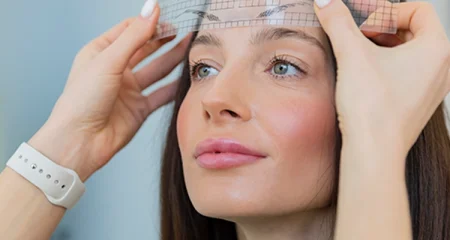
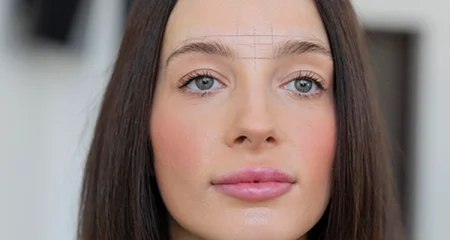
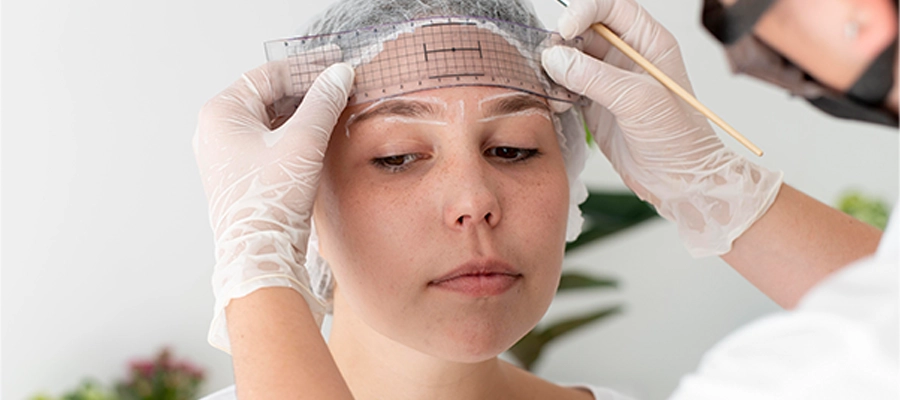
Measuring Forehead Height Before Hairline Advancement
Forehead measurements provide useful planning information, but they are only one part of the assessment. The distance between the eyebrows and hairline can vary naturally across different parts of the forehead.
Surgeons may also examine facial thirds, brow height, hairline curvature, and side-to-side differences. Photographs and digital planning can help document these relationships. Measurements guide surgery but should not replace individualized evaluation of facial proportions.
Hairline Shape as Part of Forehead Reduction Design
The shape of the hairline can be as important as its vertical position. A perfectly straight line may appear artificial because natural hairlines usually contain subtle irregularities.
Design can account for central shape, temporal transitions, widow’s peak anatomy, existing asymmetry, and hair-growth direction. The aim is to create a hairline that integrates naturally with the surrounding scalp rather than simply moving the existing border downward.
Irregular, Rounded and Feminine Hairline Patterns
Different hairline shapes can influence perceived facial character. A rounded contour or softer temporal transition may contribute to traditionally feminine proportions, while other individuals naturally have straighter or more angular patterns.
Intentional micro-irregularities can sometimes help prevent an artificially geometric appearance. However, there is no single ideal feminine or masculine hairline. Design should reflect the patient’s existing anatomy, hair characteristics, facial proportions, and desired appearance.
The Role of Scalp Mobility in Hairline Advancement
Scalp mobility is one of the main factors determining how far the hairline can be advanced safely. A relatively flexible scalp generally allows greater movement than a tight scalp.
Previous operations, scars, anatomy, and tissue characteristics can reduce mobility. Preoperative examination helps estimate potential advancement, although the final amount may depend on findings during surgery. Excessive tension should be avoided because it can affect healing and scar quality.
Endoscopic Assistance for Deeper Tissue Release
Endoscopic visualization may assist with selected deeper tissue release required to mobilize the scalp. The camera provides an enlarged view through limited access.
This can help the surgeon identify anatomical structures while working beneath the superficial tissues. Endoscopic assistance does not eliminate surgical risks or guarantee greater advancement. The degree of mobilization ultimately depends on anatomy, tissue elasticity, previous surgery, and safe dissection limits.
Reducing Tension Along the New Hairline Position
Tension management is important because the incision lies at the newly created hairline. Excessive tension can contribute to wider scars or undesirable healing.
Adequate scalp mobilization allows advancement to be distributed across deeper tissues instead of concentrating force at the skin edges. Closure technique and the amount of advancement also influence tension. Conservative planning may provide a better scar trade-off than attempting maximum possible forehead shortening.
Preserving Hair Follicles Around the Incision
Careful incision design and tissue handling are important for protecting hair follicles near the new hairline.
The direction and depth of the incision can be planned with existing hair growth in mind. Temporary shedding can occur after scalp surgery, and permanent hair loss around an incision is a potential complication. Hair density and follicle health should therefore be evaluated before surgery, particularly in patients with thinning hair.
Forehead Reduction for Naturally High Hairlines
Patients with naturally high, stable hairlines may consider forehead reduction surgery when the upper facial third appears disproportionately long.
Good candidates generally need adequate scalp mobility and sufficient hair density around the planned incision. Progressive hair loss can make the procedure less suitable because future recession may expose the scar. Hair transplantation may be an alternative or complementary option for selected hairline concerns.
Forehead Lengthening Caused by Previous Brow Lift Surgery
Certain previous brow lift techniques can alter the hairline or increase the apparent height of the forehead. Patients concerned about this change may consider hairline advancement if their anatomy permits it.
Revision planning can be more complex because previous surgery may have created scar tissue or reduced scalp mobility. Existing incisions, brow position, scalp sensation, and previous tissue dissection should be evaluated before another forehead procedure is planned.
Endoscopic-Assisted Forehead Reduction Prices 2026
Endoscopic-Assisted Forehead Reduction Prices 2026 vary according to surgical complexity, geographic location, anesthesia, required scalp advancement, and whether other procedures are performed.
Scar Position Along the New Hairline
The primary incision is generally positioned at the border between forehead skin and the advanced hairline. This allows the scar to follow the newly established hairline contour.
Hair Growth Through the Forehead Reduction Scar
Incision techniques may be designed to encourage existing hairs near the edge to help camouflage the healed scar. Over time, this can make the boundary between scalp and forehead appear less obvious.
Early Scalp Tightness and Swelling After Hairline Advancement
Tightness, swelling, tenderness, bruising, itching, and temporary numbness can occur after hairline advancement. These symptoms reflect scalp mobilization and early tissue healing.
When the New Hairline Begins to Look Natural
The new hairline is visible immediately, but swelling, incision redness, temporary shedding, and tissue tightness can initially make it appear less natural.
Factors That Influence Long-Term Hairline Position
Long-term hairline appearance depends on scalp tension, surgical fixation, tissue characteristics, genetics, aging, and future hair loss.