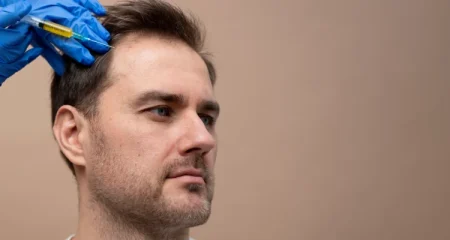


What Is Combined PRP and Mesotherapy Hair Treatment?
Combined PRP and mesotherapy hair treatment uses two injectable scalp approaches within a coordinated plan for selected forms of hair thinning. Instead of relying on one method, Combined PRP and Mesotherapy Hair Treatment brings together autologous platelet-rich plasma and a separately selected mesotherapy formulation.
PRP is prepared from the patient’s own blood and contains concentrated platelets. Mesotherapy can contain vitamins, amino acids, minerals, peptides, or other substances depending on the specific product.
The combination is generally intended to support existing follicles and scalp quality rather than recreate permanently destroyed follicles. Treatment protocols are not universally standardized, and combining two procedures does not guarantee better results than either treatment alone. The underlying cause of hair loss should therefore be identified before deciding whether a combined approach is appropriate.
How Do PRP and Mesotherapy Work Together for Hair?
PRP and mesotherapy use different materials and may target different aspects of scalp and follicle support. Within Combined PRP and Mesotherapy Hair Treatment, PRP supplies platelet-derived signaling factors, while mesotherapy delivers ingredients determined by its particular formulation.
Platelets release growth factors involved in normal tissue healing and biological signaling. Mesotherapy preparations can contain nutrients, peptides, or other compounds, although their mechanisms and supporting evidence vary between products.
Using both treatments does not necessarily create a stronger biological effect. Each component should have a clear purpose within the overall treatment plan.
Most importantly, neither procedure replaces diagnosis-specific management. Genetic pattern hair loss, nutritional deficiencies, hormonal disorders, inflammatory conditions, and scarring alopecia may require additional or alternative treatments.
Why Combine PRP with Scalp Mesotherapy?
Combination treatment may be considered when different approaches are intended to address complementary treatment goals. In selected patients, Combined PRP and Mesotherapy Hair Treatment may use PRP for follicle-focused support while mesotherapy is incorporated for additional scalp or hair-quality objectives.
The potential advantage is personalization rather than simply performing more procedures. For example, a treatment plan may focus on maintaining miniaturized follicles while also addressing selected scalp-quality concerns.
However, evidence for combined protocols can vary. A combination should not automatically be assumed to outperform properly selected PRP or other established hair-loss treatments.
Treatment also needs to consider cost, injection burden, scalp sensitivity, and recovery. Adding mesotherapy is most reasonable when there is a specific indication rather than routinely combining it with every PRP procedure.
Which Types of Hair Thinning May Benefit from Combined Treatment?
Combined treatment may be considered for selected nonscarring forms of thinning when viable follicles remain. In particular, Combined PRP and Mesotherapy Hair Treatment may be incorporated into broader management for early or moderate pattern thinning and certain diffuse hair-quality concerns.
Androgenetic alopecia is characterized by progressive follicle miniaturization and often requires long-term management. PRP may be used as an adjunct in suitable patients, while mesotherapy can have a supportive role depending on its formulation.
Temporary shedding requires evaluation of potential triggers such as illness, nutritional deficiency, stress, or hormonal changes.
Scarring alopecia, autoimmune hair loss, and inflammatory scalp disorders require diagnosis-specific assessment. Injectable supportive treatments cannot reliably restore follicles that have already been permanently destroyed.
Who Is a Suitable Candidate for PRP and Hair Mesotherapy?
Suitable candidates generally have active follicles within areas of thinning and no condition that makes scalp injections inappropriate. Following proper assessment, Combined PRP and Mesotherapy Hair Treatment may be considered when both procedures have a reasonable role within the treatment strategy.
Early follicle miniaturization may provide greater treatment potential than long-standing smooth bald areas. The cause and stage of hair loss therefore influence candidacy significantly.
Medical history, scalp health, allergies, medications, platelet-related conditions, and previous hair treatments should also be considered. The ingredients contained in the mesotherapy preparation need separate evaluation.
Candidates should have realistic expectations. The goal is generally to support existing follicles and hair quality, not guarantee complete restoration of original hair density.
Supporting Hair Follicles with Platelet-Rich Plasma and Mesotherapy
Existing follicles may become progressively smaller and produce finer hairs in conditions such as androgenetic alopecia. When follicles remain biologically active, Combined PRP and Mesotherapy Hair Treatment may be used as an adjunctive strategy intended to support the local follicular environment.
PRP provides concentrated platelets obtained from the patient’s blood. Mesotherapy introduces a separate formulation containing selected ingredients according to the treatment protocol.
These procedures cannot guarantee that miniaturized follicles will recover. Long-standing follicle damage can eventually reach a stage where nonsurgical stimulation provides limited benefit.
For progressive genetic hair loss, supportive injections may also need to be considered alongside established medical management. Preserving existing follicles is often a more realistic objective than attempting to restore completely lost hair through injections alone.
Can Combined Treatment Improve Hair Density and Thickness?
Visible density may improve when active miniaturized follicles produce thicker, stronger, or more noticeable hair shafts. For appropriately selected patients, Combined PRP and Mesotherapy Hair Treatment may support this objective, although individual outcomes can vary considerably.
PRP has been studied for its potential effects on hair density and thickness in pattern hair loss. Mesotherapy evidence is more dependent on the specific substances injected and the protocol used.
Combining these methods does not guarantee an additive effect. Improvements should be measured rather than assumed.
Permanent bald areas generally have less potential to respond because functioning follicles may no longer be available. Hair density should therefore be monitored over several months using consistent photographs and, when appropriate, scalp or hair measurements.
How Is PRP Prepared for Scalp Treatment?
PRP preparation starts by collecting a small sample of the patient’s blood into appropriate sterile tubes. Before it becomes part of Combined PRP and Mesotherapy Hair Treatment, the blood is processed using centrifugation to separate its components.
A platelet-containing plasma fraction is then collected for scalp application. Preparation methods vary according to the system used, including differences in centrifugation, platelet concentration, leukocyte content, and final plasma volume.
These variations mean that all PRP preparations are not identical. Greater platelet concentration also does not automatically mean greater clinical benefit.
Sterile processing and injection techniques remain important throughout the procedure. The prepared PRP is typically administered during the same treatment appointment according to the planned scalp injection pattern.
What Is Used in Hair Mesotherapy Alongside PRP?
Hair mesotherapy preparations may contain vitamins, amino acids, minerals, peptides, antioxidants, or other injectable ingredients. When mesotherapy is included in Combined PRP and Mesotherapy Hair Treatment, the formulation should be selected for a specific treatment purpose.
There is no single standardized mesotherapy formula for hair loss. Products can vary in their ingredients, concentrations, evidence, and regulatory status, so individual scalp sensitivity, allergies, medical history, and treatment compatibility should also be considered.
Factors that influence mesotherapy product selection include:
- Vitamin content
- Amino acids
- Minerals
- Peptides
- Antioxidants
- Other injectable ingredients
- Treatment purpose
- Product concentration
- Available evidence
- Regulatory status
- Allergy history
- Scalp sensitivity
- Medical history
- Compatibility with other procedures
What Happens During a Combined Hair Treatment Session?
A Combined PRP and Mesotherapy Hair Treatment session generally involves scalp preparation, PRP processing, treatment mapping, and a planned series of injections. The exact sequence can vary depending on the protocol and whether both treatments are performed during the same appointment.
When PRP is used, blood is collected and processed before injection. Mesotherapy may then be administered separately with its intended formulation and technique, although some protocols may schedule the two procedures on different dates to reduce injection burden or scalp irritation.
A combined hair treatment session may include:
- Blood collection for PRP
- PRP processing
- Scalp cleansing
- Treatment-area mapping
- Planned scalp injection pattern
- PRP injections
- Mesotherapy injections
- Separate injection techniques
- Different treatment dates when appropriate
How Is the Treatment Plan Personalized for Hair Loss?
Personalization begins by identifying the cause, distribution, and stage of hair loss. Before recommending Combined PRP and Mesotherapy Hair Treatment, assessment should determine whether viable follicles remain and whether both procedures have a reasonable treatment objective.
The frontal scalp, temples, mid-scalp, and crown can show different degrees of miniaturization. Treatment does not necessarily need to cover every area equally.
Age, family history, medical conditions, medications, nutritional factors, scalp health, and previous treatments can also influence planning. Laboratory assessment may be appropriate when an underlying deficiency or systemic condition is suspected.
The plan can then determine session timing, treatment areas, PRP use, mesotherapy formulation, and whether established medical hair-loss therapy should also be included.
How Many Combined PRP and Mesotherapy Sessions May Be Needed?
Session requirements vary according to the diagnosis, severity of thinning, treatment protocol, and individual response. An initial Combined PRP and Mesotherapy Hair Treatment program may involve several planned appointments followed by reassessment rather than one isolated session.
There is no universally accepted number of combined treatments. PRP protocols vary, while mesotherapy schedules differ further because formulations are not standardized.
Hair grows slowly, so sufficient time should be allowed to evaluate whether the treatment is producing measurable changes. Performing increasingly frequent injections does not guarantee greater improvement.
Further or maintenance sessions should depend on response. Standardized photographs, changes in shedding, scalp examination, and hair-quality assessment can help guide decisions about continuing treatment.
Scalp Care and Recovery After Treatment
Temporary injection-site reactions are common after scalp procedures. Following Combined PRP and Mesotherapy Hair Treatment, patients may experience redness, tenderness, mild swelling, pinpoint bleeding, small bumps, or occasional bruising.
The scalp should be treated gently during the early recovery period. Excessive scratching, rubbing, or use of irritating scalp products may need to be avoided according to treatment-specific instructions.
Hair washing and return to exercise can depend on the injection protocol and products used. When PRP and mesotherapy are performed together, aftercare should account for both procedures.
Increasing pain, spreading redness, significant swelling, warmth, drainage, fever, or other unusual symptoms require medical evaluation because they may indicate infection, inflammation, or another complication.
When Can Changes in Hair Growth and Quality Be Noticed?
Hair changes take time because follicles progress through natural growth cycles. After Combined PRP and Mesotherapy Hair Treatment, potential improvements in shedding, thickness, or density are generally assessed over several months rather than immediately after injections.
Changes in shedding may become apparent before improvements in visible density. Existing follicles must produce hairs that grow sufficiently before thicker hair can noticeably affect scalp coverage.
The timeline depends on diagnosis, degree of miniaturization, age, genetics, treatment protocol, and individual response.
Standardized photographs can make gradual changes easier to assess. Similar lighting, camera position, hair length, and styling should be used because inconsistent photographs can create a misleading impression of improvement or deterioration.
Combined PRP and Mesotherapy Hair Treatment Prices 2026
Treatment costs depend on the PRP preparation process, mesotherapy formulation, number of sessions, treatment area, and overall complexity of the hair-loss plan. When estimating Combined PRP and Mesotherapy Hair Treatment prices, both the initial course and possible maintenance procedures should be considered.
Frequently Asked Questions
Is combining PRP and mesotherapy better than using either treatment alone?
Combination treatment is not automatically more effective than either approach individually. When Combined PRP and Mesotherapy Hair Treatment is considered, each component should have a specific purpose based on the diagnosis, scalp condition, evidence, and individual treatment goals.
Can PRP and mesotherapy be performed during the same session?
Both procedures can be incorporated into the same appointment in selected protocols, although separate scheduling may sometimes be preferred. During Combined PRP and Mesotherapy Hair Treatment, timing should consider the products used, scalp sensitivity, injection burden, and recovery.
Does combined PRP and mesotherapy help with thinning hair?
Selected patients with viable follicles may experience improvements in hair quality or visible density. However, Combined PRP and Mesotherapy Hair Treatment cannot reliably restore follicles that have been permanently destroyed, and results depend strongly on the cause of thinning.
Can this treatment improve hair thickness and density?
Existing miniaturized follicles may produce thicker or more visible hairs when they respond appropriately. With Combined PRP and Mesotherapy Hair Treatment, improvement varies according to follicle viability, diagnosis, treatment protocol, and individual biological response.
How many combined treatment sessions are usually needed?
Several sessions may be included in an initial treatment course, but there is no universal number for every patient. During Combined PRP and Mesotherapy Hair Treatment, continued sessions should depend on the protocol, response, scalp condition, and measurable progress.
How often should PRP and mesotherapy sessions be performed?
Treatment intervals vary according to the PRP protocol and mesotherapy formulation. When Combined PRP and Mesotherapy Hair Treatment is repeated, adequate scalp recovery and treatment response should guide timing rather than using one fixed schedule for everyone.
When can I expect to notice changes in my hair?
Visible hair changes generally require several months because the hair-growth cycle is slow. Following Combined PRP and Mesotherapy Hair Treatment, changes in shedding may appear before noticeable improvements in shaft thickness, density, or overall scalp coverage.