

What Is PRP Treatment for Hair Loss?
PRP is an autologous procedure that uses a concentrated platelet-containing portion of a person’s own blood to support existing hair follicles. In appropriate cases, PRP Treatment for Hair Loss is mainly used for thinning areas where follicles remain present rather than completely bald regions with permanent follicle loss.
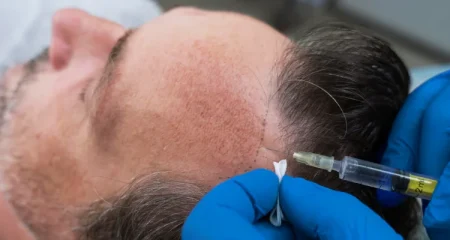
Treatment begins with a blood draw followed by centrifugation to prepare platelet-rich plasma. The resulting plasma is then injected into selected areas of the scalp using multiple small injections.
PRP is commonly considered for pattern hair loss and early follicle miniaturization. It does not provide guaranteed regrowth and cannot reliably create new follicles after permanent destruction. Results depend on the cause and stage of hair loss, preparation technique, treatment schedule, age, genetics, and individual response.
How Does PRP Work for Thinning Hair?
PRP works by delivering concentrated platelets and their associated signaling proteins into areas containing active but weakened follicles. During PRP Treatment for Hair Loss, platelet-derived factors are introduced into the scalp to influence biological processes associated with tissue repair and follicle activity.
Platelets release several growth factors after activation. These signaling molecules are involved in normal healing and may influence the environment surrounding hair follicles. Research suggests that PRP can support hair density and shaft thickness in some patients with pattern hair loss.
The treatment is more likely to have potential where miniaturized follicles remain. It cannot reliably restore areas where follicles have been permanently destroyed.
Individual responses vary because platelet concentration, preparation systems, injection methods, genetics, and the severity of thinning are not identical between patients.
How Is Platelet-Rich Plasma Prepared for Hair Treatment?
PRP preparation begins by collecting a small amount of blood into appropriate sterile tubes. Before PRP Treatment for Hair Loss is performed, the blood is centrifuged to separate its components according to their physical characteristics.
The platelet-containing plasma fraction is then collected for treatment. Preparation systems differ in centrifugation speed, processing stages, final platelet concentration, leukocyte content, and plasma volume.
These differences mean that every PRP preparation is not biologically identical. A higher platelet concentration also does not automatically guarantee a better clinical outcome.
Sterile handling is important throughout blood collection, processing, and injection. Once preparation is complete, the PRP is typically used during the same treatment session and injected into the targeted scalp regions.
Which Types of Hair Loss May Respond to PRP?
PRP is most commonly considered for nonscarring forms of hair thinning in which viable follicles remain. Among potential indications, PRP Treatment for Hair Loss is frequently used as an adjunctive option for androgenetic alopecia affecting men or women.
Patients with early or moderate follicle miniaturization may have greater potential for improvement than those with long-standing complete baldness. PRP is not an appropriate universal treatment for every form of shedding.
Nutritional deficiencies, thyroid problems, autoimmune conditions, medications, and inflammatory scalp disorders require management of their underlying causes. Scarring alopecia requires particular caution because follicles can be permanently destroyed.
Accurate diagnosis should therefore come before treatment. PRP cannot compensate for an untreated medical condition responsible for ongoing hair loss.
Who Is a Suitable Candidate for Hair PRP?
Suitable candidates generally have thinning hair with follicles that remain biologically active. After evaluating the scalp and pattern of loss, PRP Treatment for Hair Loss may be considered for selected people with androgenetic alopecia or progressive follicle miniaturization.
The treatment may be less useful for smooth areas that have remained completely bald for a long period. Expectations should therefore reflect the stage of hair loss.
Medical history also matters. Platelet disorders, clotting problems, certain medications, active scalp infections, and other health conditions can influence suitability or treatment planning.
PRP should not automatically replace established medical treatment when another therapy is indicated. It can instead form one part of a broader hair-loss management strategy when appropriate.
PRP for Early-Stage Hair Thinning
Early-stage thinning occurs when follicles begin producing progressively finer, shorter, and less visible hairs. Because these follicles may still remain active, PRP Treatment for Hair Loss can be considered before miniaturization progresses to advanced hair loss.
The main objective is generally to support existing follicles and improve visible density or shaft thickness rather than create completely new follicles. Early treatment may also be combined with diagnosis-specific medical management.
Not every person experiencing early thinning needs PRP. Temporary shedding from stress, illness, nutritional deficiency, or another trigger may require a different approach.
Identifying androgenetic alopecia or another cause first allows treatment to target the actual problem. Progress can then be monitored through standardized photographs and scalp assessment over several months.
Can PRP Help Improve Hair Density and Thickness?
Hair density can appear better when miniaturized follicles begin producing thicker or more visible hair shafts. In selected patients, PRP Treatment for Hair Loss may improve measurable density and hair thickness, although the degree of response varies.
PRP cannot increase density beyond what remaining follicles can biologically support. Areas with permanent follicle destruction are therefore unlikely to respond in the same way as early thinning areas.
Visible improvement also takes time because treated hairs must progress through their normal growth cycles. Changes are generally assessed over months rather than immediately after injections.
Genetics, age, severity of miniaturization, underlying diagnosis, preparation method, and treatment consistency can all influence the final outcome. Maintenance may be considered when a beneficial response is achieved.
How Is PRP Applied to the Scalp?
Prepared PRP is usually delivered through multiple small injections distributed across the targeted areas of thinning. During PRP Treatment for Hair Loss, injection depth, spacing, and the amount placed in each area can vary according to the selected protocol.
The scalp is cleaned before treatment, and pain-control measures may be used when appropriate. The platelet-rich plasma is then injected systematically into areas where follicle support is desired.
Patients may experience pressure, stinging, or temporary tenderness during the procedure. Pinpoint bleeding can also occur at individual injection sites.
PRP application should focus on areas containing potentially responsive follicles. Injecting completely bald regions does not mean that new follicles will automatically develop, particularly when permanent follicle loss has already occurred.
Which Areas of the Scalp Can Be Treated with PRP?
PRP can be applied to several scalp areas affected by nonscarring hair thinning. Depending on the pattern of hair loss, PRP Treatment for Hair Loss may target the frontal scalp, hairline, mid-scalp, crown, or more diffuse areas where miniaturized follicles are still present.
The treatment area should be planned according to the actual distribution of hair loss rather than injecting unaffected scalp uniformly. Areas with functioning but weakened follicles are generally more suitable than completely bald regions without active follicles.
Scalp areas that may be treated with PRP include:
- Frontal scalp
- Hairline region
- Mid-scalp
- Crown area
- Diffuse thinning areas
- Regions with miniaturized follicles
- Areas with early-stage hair loss
- Selected zones with remaining follicle activity
- Regions identified through scalp examination
How Many PRP Sessions Are Usually Needed for Hair Loss?
The number of PRP sessions needed for hair loss varies according to the degree of thinning, treatment protocol, and individual response. PRP Treatment for Hair Loss commonly involves an initial series of sessions rather than a single treatment.
Many protocols use several sessions spaced over a period of months, followed by reassessment. Because hair growth is slow, enough time should be allowed before determining whether density or hair thickness has improved.
Factors that influence the number of PRP sessions include:
- Degree of hair thinning
- Pattern of hair loss
- Individual treatment response
- PRP treatment protocol
- Time between sessions
- Hair density changes
- Hair thickness improvement
How Often Should Hair PRP Be Repeated?
Treatment intervals depend on the initial protocol, severity of thinning, and response to previous sessions. During an initial PRP Treatment for Hair Loss program, treatments are generally spaced apart rather than performed continuously over short intervals.
After the initial series, some patients may move to periodic maintenance. The appropriate frequency depends partly on whether the underlying condition, such as androgenetic alopecia, continues to progress.
PRP does not permanently switch off genetic hair loss. Benefits may therefore decrease over time if ongoing follicle miniaturization continues.
More frequent treatment does not automatically provide greater improvement. Repetition should be guided by clinical response, scalp condition, photographs, other hair-loss treatments, and the overall management plan.
What to Expect After a Scalp PRP Session
Temporary scalp tenderness, redness, swelling, or pinpoint bleeding can occur following PRP injections. After PRP Treatment for Hair Loss, these effects are generally mild and gradually settle during the early recovery period.
Some people may experience temporary scalp sensitivity, tightness, or mild discomfort around injection sites. Bruising is also possible, although it does not occur in every patient.
Hair and scalp care instructions can vary according to the injection protocol. Aggressive rubbing, scratching, or irritating scalp products may need to be avoided during the initial recovery period.
Increasing pain, significant swelling, spreading redness, drainage, fever, or other unusual symptoms should be medically assessed because they may indicate a complication rather than an expected post-treatment response.
When Can Hair Growth Changes Become Noticeable?
Hair changes require time because follicles progress through natural growth and resting cycles. Following PRP Treatment for Hair Loss, visible differences are generally evaluated over several months rather than within the first few days or weeks.
Some patients may first notice changes in shedding or hair quality. Improvements in thickness and visible density require existing hairs to grow sufficiently before they affect overall appearance.
Response speed varies according to the diagnosis, stage of thinning, age, treatment schedule, and individual follicle activity. Not every patient responds at the same rate.
Standardized photographs are useful because day-to-day changes can be difficult to recognize. Consistent lighting, hairstyle, hair length, and camera angle make comparisons more meaningful.
PRP Hair Treatment Maintenance and Follow-Up
Follow-up is important for determining whether treatment is producing meaningful changes in shedding, thickness, or visible density. After an initial PRP Treatment for Hair Loss course, progress can be assessed through scalp examination, standardized photographs, and discussion of ongoing hair loss.
Maintenance may be considered when improvement has occurred but the underlying condition remains progressive. This is particularly relevant for genetic pattern hair loss, which can continue throughout adulthood.
PRP may also be used alongside appropriate medical management. Follow-up allows these treatments to be adjusted when necessary.
Maintenance schedules should not be automatic. If PRP produces little measurable benefit after an appropriate assessment period, continuing repeated sessions indefinitely may not be useful, and the diagnosis or treatment strategy should be reconsidered.
PRP Treatment for Hair Loss Prices 2026
Treatment costs vary according to the number of sessions, scalp area being treated, preparation protocol, and whether PRP is combined with other hair-loss therapies. When calculating PRP Treatment for Hair Loss prices, the complete initial treatment course and potential maintenance requirements should both be considered.
Frequently Asked Questions
Does PRP really work for hair loss?
Research indicates that PRP can improve hair density or thickness in some appropriately selected patients, particularly with pattern hair loss. However, results from PRP Treatment for Hair Loss vary according to follicle viability, preparation technique, disease stage, and individual response.
Can PRP regrow lost hair?
Miniaturized follicles that remain active may produce thicker and more visible hairs after successful treatment. However, PRP Treatment for Hair Loss cannot reliably create new follicles in areas where long-standing hair loss or scarring has permanently destroyed them.
Is PRP effective for a receding hairline?
A receding hairline may respond when miniaturized follicles are still present in the affected region. In these cases, PRP Treatment for Hair Loss may support existing hairs, while completely lost hairline areas are less likely to regrow without surgical restoration.
How many PRP sessions are needed for hair loss?
Several initial sessions are commonly used before the response is properly assessed. With PRP Treatment for Hair Loss, the exact number varies according to the protocol, severity of thinning, underlying diagnosis, and changes observed during follow-up.
How long does it take to see results from hair PRP?
Visible changes generally require several months because hair grows through a slow biological cycle. Following PRP Treatment for Hair Loss, improvements in shedding may become apparent before noticeable changes in shaft thickness or overall density.
How long do PRP hair treatment results last?
The duration of improvement varies according to the underlying hair-loss condition and individual response. After successful PRP Treatment for Hair Loss, benefits may gradually decrease as genetic or age-related follicle miniaturization continues, making periodic maintenance appropriate for some patients.
Can PRP make existing hair thicker?
Existing miniaturized hairs may become thicker in some appropriately selected patients when follicles remain functional. Through PRP Treatment for Hair Loss, the potential improvement depends on the stage of miniaturization, underlying diagnosis, treatment response, and condition of the remaining follicles.